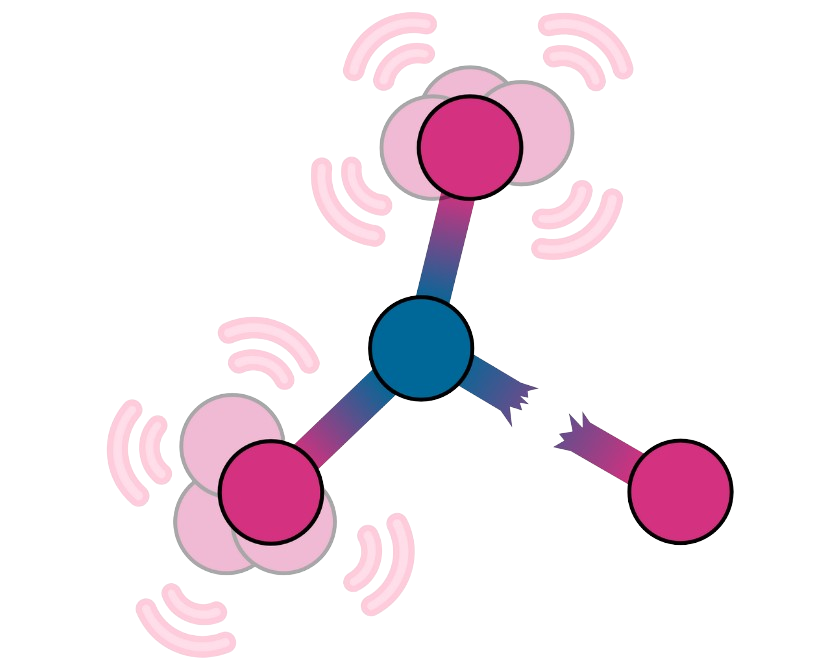
"""
Module containing functions to generate rattled and bond-distorted structures,
as well as input files to run Gamma point relaxations with ``VASP``, ``CP2K``,
``Quantum-Espresso``, ``FHI-aims`` and ``CASTEP``.
"""
import contextlib
import copy
import datetime
import os
import shutil
import warnings
from pathlib import Path
import ase
import numpy as np
from ase.calculators.castep import Castep
from doped import _ignore_pmg_warnings
from doped.core import Defect, DefectEntry, guess_and_set_oxi_states_with_timeout, most_common_oxi
from doped.generation import DefectsGenerator, name_defect_entries
from doped.utils.efficiency import StructureMatcher_scan_stol
from doped.utils.parsing import (
get_defect_type_and_composition_diff,
get_defect_type_site_idxs_and_unrelaxed_structure,
)
from doped.vasp import DefectDictSet
from monty.json import MontyDecoder
from monty.serialization import dumpfn, loadfn
from pymatgen.analysis.defects import thermo
from pymatgen.analysis.defects.supercells import get_sc_fromstruct
from pymatgen.analysis.structure_matcher import ElementComparator
from pymatgen.core.structure import Composition, PeriodicSite, Structure
from pymatgen.entries.computed_entries import ComputedStructureEntry
from pymatgen.io.ase import AseAtomsAdaptor
from pymatgen.io.cp2k.inputs import Cp2kInput
from pymatgen.io.vasp.inputs import Kpoints
from pymatgen.io.vasp.sets import BadInputSetWarning
from tqdm import tqdm
from shakenbreak.analysis import _get_distortion_filename
from shakenbreak.distortions import _get_stdev_and_d_min, distort_and_rattle
from shakenbreak.io import parse_fhi_aims_input, parse_qe_input
MODULE_DIR = os.path.dirname(os.path.abspath(__file__))
default_potcar_dict = loadfn(f"{MODULE_DIR}/SnB_input_files/default_POTCARs.yaml")
# Load default INCAR settings for the ShakeNBreak geometry relaxations
default_incar_settings = loadfn(os.path.join(MODULE_DIR, "SnB_input_files/incar.yaml"))
_ignore_pmg_warnings() # Ignore pymatgen POTCAR warnings
def _warning_on_one_line(message, category, filename, lineno, file=None, line=None) -> str:
"""Output warning messages on one line."""
# To set this as warnings.formatwarning, we need to be able to take in ``file``
# and ``line``, but don't want to print them, so unused arguments here
return f"{os.path.split(filename)[-1]}:{lineno}: {category.__name__}: {message}\n"
warnings.formatwarning = _warning_on_one_line
# Helper functions
[docs]
def bold_print(string: str) -> None:
"""
Prints the input string in bold.
Args:
string (:obj:`str`): String to print in bold.
"""
print("\033[1m" + string + "\033[0m")
def _create_folder(folder_name: str) -> None:
"""Creates a folder at ``./folder_name`` if it doesn't already exist."""
path = os.getcwd()
if not os.path.isdir(f"{path}/{folder_name}"):
try:
os.makedirs(f"{path}/{folder_name}", exist_ok=True)
except OSError:
print(f"Creation of the directory {path} failed")
def _write_distortion_metadata(
new_metadata: dict,
filename: str = "distortion_metadata.json",
output_path: str = ".",
) -> None:
"""
Write distortion metadata to file.
If the file already exists then the previous metadata will be
renamed to ``distortion_metadata_<datetime>.json`` (if it differs
from the current metadata), and also combined with the current
metadata if compatible (i.e. if they are using similar distortion
parameters and only differ in the set of defects / charge states /
distortions used), before writing this combined metadata to file.
Args:
new_metadata (:obj:`dict`):
Distortion metadata containing distortion parameters used, as well as information
about the defects and their charge states modelled.
filename (:obj:`str`, optional):
Filename to save metadata. Defaults to "distortion_metadata.json".
output_path (:obj:`str`):
Path to directory in which to write distortion_metadata.json file.
(Default is current directory = "./")
Returns:
None
"""
filepath = os.path.join(output_path, filename)
if os.path.exists(filepath):
try:
old_metadata = loadfn(os.path.join(output_path, "distortion_metadata.json"))
if old_metadata: # convert charge keys back to integers (converted to strings when saved to /
# loaded from JSON)
for defect in list(old_metadata["defects"].keys()):
charges_dict = old_metadata["defects"][defect]["charges"]
old_metadata["defects"][defect] = {
k: v for k, v in old_metadata["defects"][defect].items() if k != "charges"
}
old_metadata["defects"][defect]["charges"] = {
int(k): v for k, v in charges_dict.items()
}
if old_metadata and old_metadata != new_metadata:
current_datetime = datetime.datetime.now().strftime(
"%Y-%m-%d-%H-%M"
) # current time for renaming old metadata file
# if new/old metadata are subsets of one another, then combine quietly and don't write
# new file:
are_subsets = new_metadata["distortion_parameters"] == old_metadata[
"distortion_parameters"
] and (
all(
{
k: v
for k, v in new_metadata["defects"]
.get(defect, {"charges": {None: None}})["charges"]
.get(charge, {None: None})
.items()
if k != "distortion_parameters"
}
== {
k: v
for k, v in old_metadata["defects"]
.get(defect, {"charges": {None: None}})["charges"]
.get(charge, {None: None})
.items()
if k != "distortion_parameters"
}
for defect in new_metadata["defects"]
for charge in new_metadata["defects"][defect]["charges"]
)
or all(
{
k: v
for k, v in new_metadata["defects"]
.get(defect, {"charges": {None: None}})["charges"]
.get(charge, {None: None})
.items()
if k != "distortion_parameters"
}
== {
k: v
for k, v in old_metadata["defects"]
.get(defect, {"charges": {None: None}})["charges"]
.get(charge, {None: None})
.items()
if k != "distortion_parameters"
}
for defect in old_metadata["defects"]
for charge in old_metadata["defects"][defect]["charges"]
)
)
if not are_subsets:
print(
f"There is a previous version of {filepath} with differences to the current "
f"`distortion_metadata`. Will rename old metadata file to "
f"distortion_metadata_{current_datetime}.json"
)
os.rename(
filepath,
os.path.join(output_path, f"distortion_metadata_{current_datetime}.json"),
)
print(f"Combining old and new metadata in {filename}.")
# Combine old and new metadata dictionaries
for defect in old_metadata["defects"]:
if defect in new_metadata["defects"]: # if defect in both metadata files
for charge in old_metadata["defects"][defect]["charges"]:
if (
charge in new_metadata["defects"][defect]["charges"]
): # if charge state in both files,
# then we update the mesh of distortions if this is the only differing
# quantity (i.e. [-0.3, 0.3] + [-0.4, -0.2, 0.2, 0.4])
new_metadata_charge_dict_wout_distortions_list = copy.deepcopy(
new_metadata["defects"][defect]["charges"][charge]
)
new_metadata_charge_dict_wout_distortions_list["distortion_parameters"] = {
k: v
for k, v in new_metadata_charge_dict_wout_distortions_list[
"distortion_parameters"
].items()
if k not in ["bond_distortions", "distortion_increment"]
}
old_metadata_charge_dict_wout_distortions_list = copy.deepcopy(
old_metadata["defects"][defect]["charges"][charge]
)
old_metadata_charge_dict_wout_distortions_list["distortion_parameters"] = {
k: v
for k, v in old_metadata_charge_dict_wout_distortions_list[
"distortion_parameters"
].items()
if k not in ["bond_distortions", "distortion_increment"]
}
if (
new_metadata_charge_dict_wout_distortions_list
== old_metadata_charge_dict_wout_distortions_list
):
if (
new_metadata["defects"][defect]["charges"][charge][
"distortion_parameters"
]
!= old_metadata["defects"][defect]["charges"][charge][
"distortion_parameters"
]
):
# combine bond distortions lists:
old_bond_distortions = old_metadata["defects"][defect]["charges"][
charge
]["distortion_parameters"]["bond_distortions"]
bond_distortions = old_bond_distortions + [
distortion
for distortion in new_metadata["defects"][defect]["charges"][
charge
]["distortion_parameters"]["bond_distortions"]
if distortion not in old_bond_distortions
]
new_metadata["defects"][defect]["charges"][charge][
"distortion_parameters"
] = {
"bond_distortions": bond_distortions,
**{
k: v
for k, v in new_metadata["defects"][defect]["charges"][
charge
]["distortion_parameters"].items()
if k
not in [
"bond_distortions",
"distortion_increment",
]
},
}
else: # different number of neighbours distorted in new run
warnings.warn(
f"Previous and new metadata show different distortion parameters "
f"for {defect} in charge {'+' if charge > 0 else ''}{charge}. "
f"{filepath} will only show the new distortion parameters."
)
continue
else: # if charge state only in old metadata, add it to file
new_metadata["defects"][defect]["charges"][charge] = old_metadata[
"defects"
][defect]["charges"][charge]
else:
new_metadata["defects"][defect] = old_metadata["defects"][
defect
] # else add new entry
except KeyError:
os.rename( # ensure previous file saved over, even if subset
filepath,
os.path.join(output_path, f"distortion_metadata_{current_datetime}.json"),
)
warnings.warn(
f"There was a problem when combining old and new metadata files! Will only write "
f"new metadata to {filepath}."
)
dumpfn(obj=new_metadata, fn=filepath, indent=4)
def _create_vasp_input(
defect_name: str,
distorted_defect_dict: dict,
user_incar_settings: dict | None = None,
user_potcar_functional: str | None = "PBE",
user_potcar_settings: dict | None = None,
output_path: str = ".",
**kwargs,
) -> str:
r"""
Creates folders for storing VASP ShakeNBreak files.
Args:
defect_name (:obj:`str`):
Folder name
distorted_defect_dict (:obj:`dict`):
Dictionary with the distorted structures of charged defect
user_incar_settings (:obj:`dict`):
Dictionary of user VASP INCAR settings, to overwrite/update the
``doped`` defaults.
user_potcar_functional (str):
POTCAR functional to use. Default is "PBE" and if this fails,
tries "PBE_52", then "PBE_54".
user_potcar_settings (:obj:`dict`):
Dictionary of user VASP POTCAR settings, to overwrite/update
the ``doped`` defaults (e.g. {'Fe': 'Fe_pv', 'O': 'O'}}). Highly
recommended to look at output ``POTCAR``\s, or
``shakenbreak/SnB_input_files/default_POTCARs.yaml``, to see what
the default ``POTCAR`` settings are. (Default: None)
output_path (:obj:`str`):
Path to directory in which to write distorted defect structures and
calculation inputs.
(Default is current directory = "./")
**kwargs:
Keyword arguments to pass to ``DefectDictSet.write_input()`` (e.g.
``potcar_spec``).
Returns:
:obj:`str`:
The final defect folder name (in case it was renamed due to duplicate
folder names etc).
"""
# create folder for defect
defect_name_wout_charge, charge_state = defect_name.rsplit("_", 1) # ``defect_name`` includes charge
charge_state = int(charge_state)
test_letters = [
"h",
"g",
"f",
"e",
"d",
"c",
"b",
"a",
"",
] # reverse search to determine
# last letter used
try:
matching_dirs = [
dir
for letter in test_letters
for dir in os.listdir(output_path)
if dir == f"{defect_name_wout_charge}{letter}_{'+' if charge_state > 0 else ''}{charge_state}"
and os.path.isdir(
f"{output_path}/{defect_name_wout_charge}{letter}_{'+' if charge_state > 0 else ''}"
f"{charge_state}"
)
]
except Exception:
matching_dirs = []
if matching_dirs: # defect species with same name already present
# check if Unperturbed structures match
# first check if any SnB folders are present in matching_dirs (if so then need to check if
# structures match), otherwise we can write to this same folder
match_found = not any(
any(
x in i
for i in os.listdir(os.path.join(output_path, dir))
for x in ["Unperturbed", "Rattled", "Bond_Distortion"]
)
for dir in matching_dirs
)
if not match_found: # SnB folders in matching_dirs, so check if Unperturbed structures match
for dir in matching_dirs:
with contextlib.suppress(Exception): # if Unperturbed structure could not be parsed /
# compared to distorted_defect_dict, then pass
prev_unperturbed_struct = Structure.from_file(
f"{output_path}/{dir}/Unperturbed/POSCAR"
)
current_unperturbed_struct = distorted_defect_dict["Unperturbed"][
"Defect Structure"
].copy()
if StructureMatcher_scan_stol( # tight StructureMatcher
prev_unperturbed_struct,
current_unperturbed_struct,
func_name="fit",
stol=0.02,
ltol=0.02,
angle_tol=0.5,
primitive_cell=False,
attempt_supercell=False,
comparator=ElementComparator(),
):
warnings.warn(
f"The previously-generated defect distortions folder {dir} in "
f"{os.path.basename(os.path.abspath(output_path))} has the same Unperturbed "
f"defect structure as the current defect species: {defect_name}. ShakeNBreak "
f"files in {dir} will be overwritten."
)
defect_name = dir
match_found = True
break
if not match_found: # no matching structure found, assume inequivalent defects
last_letter = next(
letter
for letter in test_letters
for dir in matching_dirs
if dir
== f"{defect_name_wout_charge}{letter}_{'+' if charge_state > 0 else ''}{charge_state}"
)
prev_dir_name = (
f"{defect_name_wout_charge}{last_letter}_{'+' if charge_state > 0 else ''}"
f"{charge_state}"
)
if last_letter == "": # rename prev defect folder
new_prev_dir_name = (
f"{defect_name_wout_charge}a_{'+' if charge_state > 0 else ''}{charge_state}"
)
new_current_dir_name = (
f"{defect_name_wout_charge}b_{'+' if charge_state > 0 else ''}{charge_state}"
)
warnings.warn(
f"A previously-generated defect distortions folder {prev_dir_name} exists in "
f"{os.path.basename(os.path.abspath(output_path))}, "
f"and the Unperturbed defect structure could not be matched to the "
f"current defect species: {defect_name}. These are assumed to be "
f"inequivalent defects, so the previous {prev_dir_name} will be "
f"renamed to {new_prev_dir_name} and ShakeNBreak files for the "
f"current defect will be saved to {new_current_dir_name}, "
f"to prevent overwriting."
)
shutil.move(
f"{output_path}/{prev_dir_name}",
f"{output_path}/{new_prev_dir_name}",
)
else: # don't rename prev defect folder just rename current folder
next_letter = test_letters[test_letters.index(last_letter) - 1]
new_current_dir_name = (
f"{defect_name_wout_charge}{next_letter}"
f"_{'+' if charge_state > 0 else ''}{charge_state}"
)
warnings.warn(
f"Previously-generated defect distortions folders ({prev_dir_name}...) exist in "
f"{os.path.basename(os.path.abspath(output_path))}, "
f"and the Unperturbed defect structures could not be matched to the "
f"current defect species: {defect_name}. These are assumed to be "
f"inequivalent defects, so ShakeNBreak files for the current defect "
f"will be saved to {new_current_dir_name} to prevent overwriting."
)
defect_name = new_current_dir_name
_create_folder(os.path.join(output_path, defect_name))
potcar_settings = copy.deepcopy(default_potcar_dict)["POTCAR"]
potcar_settings.update(user_potcar_settings or {})
incar_settings = copy.deepcopy(default_incar_settings)
incar_settings.update(user_incar_settings or {})
single_defect_dict = next(iter(distorted_defect_dict.values()))
num_elements = len(single_defect_dict["Defect Structure"].composition.elements)
incar_settings.update({"ROPT": ("1e-3 " * num_elements).rstrip()})
dds = DefectDictSet( # create one DefectDictSet first, then just edit structure & comment for each
single_defect_dict["Defect Structure"],
charge_state=single_defect_dict["Charge State"],
user_incar_settings=incar_settings,
user_kpoints_settings=Kpoints().from_dict(
{
"comment": "Γ-only KPOINTS from ShakeNBreak",
"generation_style": "Gamma",
}
),
user_potcar_functional=user_potcar_functional,
user_potcar_settings=potcar_settings,
poscar_comment=None,
)
for (
distortion,
single_defect_dict,
) in distorted_defect_dict.items(): # for each distortion, create subfolder
dds._structure = single_defect_dict["Defect Structure"].get_sorted_structure() # ensure sorted
dds.poscar_comment = single_defect_dict.get("POSCAR Comment", None)
dds.write_input(
f"{output_path}/{defect_name}/{distortion}",
poscar=True,
rattle=False, # way ahead of you pal
snb=True,
**kwargs,
)
return defect_name
def _get_bulk_comp(defect_object) -> Composition:
"""
Convenience function to determine the chemical composition of the bulk
structure for a given defect. Useful for auto-determing oxidation states.
Args:
defect_object (:obj:`Defect`):
doped.core.Defect object.
Returns:
Pymatgen Composition object for the bulk structure of the defect.
"""
bulk_structure = defect_object.structure
return bulk_structure.composition
def _get_bulk_defect_site(
defect_entry: DefectEntry,
) -> PeriodicSite:
"""Get defect site in the bulk structure (e.g.
for a P substitution on Si, get the original Si site).
"""
defect_object = defect_entry.defect
defect_type = defect_object.defect_type.name.lower()
if defect_type not in ["antisite", "substitution"]:
return PeriodicSite(
species=defect_object.site.species,
coords=defect_entry.sc_defect_frac_coords,
coords_are_cartesian=False,
lattice=defect_entry.sc_entry.structure.lattice,
)
# get bulk_site
sub_site_in_bulk = defect_object.defect_site # bulk site of substitution
sub_site_in_bulk_species = sub_site_in_bulk.species
return PeriodicSite(
species=sub_site_in_bulk_species,
coords=defect_entry.sc_defect_frac_coords,
coords_are_cartesian=False,
lattice=defect_entry.sc_entry.structure.lattice,
)
def _get_defect_site(
defect_entry: DefectEntry,
) -> PeriodicSite:
"""Get defect site in the defect structure (e.g.
for a P substitution on Si, get the P substitution site).
"""
try:
defect_frac_coords = defect_entry.sc_defect_frac_coords
if defect_frac_coords is None:
raise AttributeError
except AttributeError as e:
raise AttributeError(
"DefectEntry does not have a `sc_defect_frac_coords` attribute. "
"Try again setting the `defect_frac_coords` attribute when creating the DefectEntry."
) from e
defect_species = defect_entry.defect.site.species
return PeriodicSite(
species=defect_species,
coords=defect_frac_coords,
coords_are_cartesian=False,
lattice=defect_entry.sc_entry.structure.lattice,
)
def _get_defect_entry_from_defect(
defect: Defect,
charge_state: int = 0,
):
"""
Generate a ``DefectEntry`` from a ``Defect`` object, whose defect structure
corresponds to the defect supercell (rather than unit cell). This is the case
when initialising Distortions() from an old doped/pycdt defect dict or from
structures specified by the user.
"""
defect_entry = DefectEntry(
defect=defect,
charge_state=charge_state,
sc_defect_frac_coords=defect.site.frac_coords,
sc_entry=ComputedStructureEntry(
structure=defect.defect_structure,
energy=0.0, # needs to be set, so set to 0.0
),
bulk_entry=ComputedStructureEntry(
structure=defect.structure,
energy=0.0, # needs to be set, so set to 0.0
),
defect_supercell_site=defect.site,
defect_supercell=defect.defect_structure,
bulk_supercell=defect.structure,
)
if defect_entry is None:
raise ValueError("DefectEntry could not be generated.")
return defect_entry
def _calc_number_electrons(
defect_entry: DefectEntry,
defect_name: str,
oxidation_states: dict,
verbose: bool = False,
) -> int:
"""
Calculates the number of extra/missing electrons of the neutral
defect species (in ``defect_object``) based on ``oxidation_states``.
Args:
defect_entry (:obj:`DefectEntry`):
``doped.core.DefectEntry`` object.
defect_name (:obj:`str`):
Name of the defect species.
oxidation_states (:obj:`dict`):
Dictionary with oxidation states of the atoms in the material (e.g.
{"Cd": +2, "Te": -2}).
verbose (:obj:`bool`):
If True, prints the number of extra/missing electrons for the defect
species.
Returns:
:obj:`int`:
Extra/missing charge (negative of the number of extra/missing electrons).
"""
oxidation_states["Vac"] = 0 # A vacancy has an oxidation state of zero
defect_object = defect_entry.defect
# Determine number of extra/missing electrons based on defect type and
# oxidation states
defect_type = defect_object.defect_type.name.lower()
# We use the following variables:
# site_specie: Original species on the bulk site
# substitution_specie: Site occuping the defect site
if defect_type == "vacancy":
site_specie = str(defect_object.site.specie.symbol)
substitution_specie = "Vac"
elif defect_type == "interstitial":
substitution_specie = str(defect_object.site.specie.symbol)
# Consider interstitials as substituting a vacant (zero oxidation-state
# position)
site_specie = "Vac"
elif defect_type in ["antisite", "substitution"]:
# get bulk_site
sub_site_in_bulk = _get_bulk_defect_site(
defect_entry,
) # bulk site of substitution
site_specie = sub_site_in_bulk.specie.symbol # Species occuping the *bulk* site
substitution_specie = str(
defect_object.site.specie.symbol
) # Current species occupying the defect site (e.g. the substitution)
else:
raise ValueError(f"`defect_entry` has an invalid `defect_type`: {defect_type}")
num_electrons = oxidation_states[substitution_specie] - oxidation_states[site_specie]
if verbose:
print(
f"Number of extra/missing electrons of defect {defect_name}: "
f"{int(num_electrons)} -> \u0394q = {int(-num_electrons)}"
)
return int(-num_electrons)
def _calc_number_neighbours(num_electrons: int) -> int:
"""
Calculate the number of neighbours to distort based off the number of
extra/missing electrons. An octet rule approach is used; if the electron
count change is less than or equal to 4, we distort that number of
neighbours, if it is greater than 4, then we distort (8 -(electron
change) neighbours.
Args:
num_electrons (:obj:`int`): Number of extra/missing electrons for the
defect species.
Returns:
:obj:`int`:
Number of neighbours to distort
"""
return abs(8 - abs(num_electrons)) if abs(num_electrons) > 4 else abs(num_electrons)
def _get_voronoi_multiplicity(site, structure):
"""Get the multiplicity of a Voronoi site in structure."""
from doped.utils.efficiency import get_voronoi_nodes
vnodes = get_voronoi_nodes(structure)
distances_and_species_list = []
for vnode in vnodes:
distances_and_species = [
(np.round(vnode.distance(atomic_site), decimals=3), atomic_site.species)
for atomic_site in structure.sites
]
sorted_distances_and_species = sorted(distances_and_species)
distances_and_species_list.append(sorted_distances_and_species)
site_distances_and_species = [
(np.round(site.distance(atomic_site), decimals=3), atomic_site.species)
for atomic_site in structure.sites
]
sorted_site_distances_and_species = sorted(site_distances_and_species)
multiplicity = sum(
1
for distances_and_species in distances_and_species_list
if distances_and_species == sorted_site_distances_and_species
)
if multiplicity == 0:
warnings.warn(
f"Multiplicity of interstitial at site "
f"{np.around(site.frac_coords, decimals=3)} could not be determined from "
f"Voronoi analysis. Multiplicity set to 1."
)
multiplicity = 1
return multiplicity
[docs]
def identify_defect(
defect_structure,
bulk_structure,
defect_coords=None,
defect_index=None,
oxi_state=None,
) -> Defect:
"""
By comparing the defect and bulk structures, identify the defect present and its
site in the supercell, and generate a ``doped`` ``Defect`` object from this.
Args:
defect_structure (:obj:`Structure`):
Defect structure
bulk_structure (:obj:`Structure`):
Bulk structure
defect_coords (:obj:`list`):
Fractional coordinates of the defect site in the supercell.
defect_index (:obj:`int`):
Index of the defect site in the supercell. For vacancies, this
should be the site index in the bulk structure, while for substitutions
and interstitials it should be the site index in the defect structure.
oxi_state (:obj:`int`, :obj:`float`, :obj:`str`):
Oxidation state of the defect site. If not provided, will be
automatically determined from the defect structure.
Returns: :obj:`Defect`
"""
# Note: Could replace much of the code in this function with the defect_from_structures function from
# doped if we wanted, but works fine as is.
# identify defect site, structural information, and create defect object:
try:
defect_type, _comp_diff = get_defect_type_and_composition_diff(bulk_structure, defect_structure)
except RuntimeError as exc:
raise ValueError(
"Could not identify defect type from number of sites in structure: "
f"{len(bulk_structure)} in bulk vs. {len(defect_structure)} in defect?"
) from exc
# remove oxidation states before site-matching
defect_struct = defect_structure.copy() # copy to prevent overwriting original structures
bulk_struct = bulk_structure.copy()
defect_struct.remove_oxidation_states()
bulk_struct.remove_oxidation_states()
_bulk_oxi_states = False
if oxi_state is None:
if all(hasattr(site.specie, "oxi_state") for site in bulk_struct.sites) and all(
isinstance(site.specie.oxi_state, (int, float)) for site in bulk_struct.sites
):
_bulk_oxi_states = {el.symbol: el.oxi_state for el in bulk_struct.composition.elements}
else: # try guessing bulk oxi states now, before Defect initialisation:
if bulk_struct_w_oxi := guess_and_set_oxi_states_with_timeout(
bulk_struct, break_early_if_expensive=True
):
_bulk_oxi_states = {
el.symbol: el.oxi_state for el in bulk_struct_w_oxi.composition.elements
}
bulk_site_index = None
defect_site_index = None
if defect_type == "vacancy" and defect_index: # defect_index should correspond to bulk struct
bulk_site_index = defect_index
elif defect_index: # defect_index should correspond to defect struct
if defect_type == "interstitial":
defect_site_index = defect_index
if defect_type == "substitution": # also want bulk site index for substitutions,
# so use defect index coordinates
defect_coords = defect_struct[defect_index].frac_coords
if defect_coords is not None:
if bulk_site_index is None and defect_site_index is None:
site_displacement_tol = (
0.01 # distance tolerance for site matching to identify defect, increases in
# jumps of 0.1 Å
)
def _possible_sites_in_sphere(structure, frac_coords, tol):
"""Find possible sites in sphere of radius tol."""
return sorted(
structure.get_sites_in_sphere(
structure.lattice.get_cartesian_coords(frac_coords),
tol,
include_index=True,
),
key=lambda x: x[1],
)
max_possible_defect_sites_in_bulk_struct = _possible_sites_in_sphere(
bulk_struct, defect_coords, 2.5
)
max_possible_defect_sites_in_defect_struct = _possible_sites_in_sphere(
defect_struct, defect_coords, 2.5
)
expanded_possible_defect_sites_in_bulk_struct = _possible_sites_in_sphere(
bulk_struct, defect_coords, 3.0
)
expanded_possible_defect_sites_in_defect_struct = _possible_sites_in_sphere(
defect_struct, defect_coords, 3.0
)
# there should be one site (including specie identity) which does not match between
# bulk and defect structures
def _remove_matching_sites(bulk_site_list, defect_site_list):
"""Remove matching sites from bulk and defect structures."""
bulk_sites_list = list(bulk_site_list)
defect_sites_list = list(defect_site_list)
for defect_site in defect_sites_list:
for bulk_site in bulk_sites_list:
if (
defect_site.distance(bulk_site) < 0.5
and defect_site.specie == bulk_site.specie
):
if bulk_site in bulk_sites_list:
bulk_sites_list.remove(bulk_site)
if defect_site in defect_sites_list:
defect_sites_list.remove(defect_site)
return bulk_sites_list, defect_sites_list
non_matching_bulk_sites, _ = _remove_matching_sites(
max_possible_defect_sites_in_bulk_struct,
expanded_possible_defect_sites_in_defect_struct,
)
_, non_matching_defect_sites = _remove_matching_sites(
expanded_possible_defect_sites_in_bulk_struct,
max_possible_defect_sites_in_defect_struct,
)
if len(non_matching_bulk_sites) == 0 and len(non_matching_defect_sites) == 0:
warnings.warn(
f"Coordinates {defect_coords} were specified for (auto-determined) "
f"{defect_type} defect, but there are no extra/missing/different species "
f"within a 2.5 Å radius of this site when comparing bulk and defect "
f"structures. "
f"If you are trying to generate non-defect polaronic distortions, please use "
f"the distort() and rattle() functions in shakenbreak.distortions via the "
f"Python API. "
f"Reverting to auto-site matching instead."
)
else:
searched = "bulk or defect"
possible_defects = []
while site_displacement_tol < 5: # loop over distance tolerances
possible_defect_sites_in_bulk_struct = _possible_sites_in_sphere(
bulk_struct, defect_coords, site_displacement_tol
)
possible_defect_sites_in_defect_struct = _possible_sites_in_sphere(
defect_struct, defect_coords, site_displacement_tol
)
if (
defect_type == "vacancy"
): # defect site should be in bulk structure but not defect structure
possible_defects, _ = _remove_matching_sites(
possible_defect_sites_in_bulk_struct,
expanded_possible_defect_sites_in_defect_struct,
)
searched = "bulk"
if len(possible_defects) == 1:
bulk_site_index = possible_defects[0][2]
break
else: # interstitial or substitution
# defect site should be in defect structure but not bulk structure
_, possible_defects = _remove_matching_sites(
expanded_possible_defect_sites_in_bulk_struct,
possible_defect_sites_in_defect_struct,
)
searched = "defect"
if len(possible_defects) == 1:
if defect_type == "substitution":
possible_defects_in_bulk, _ = _remove_matching_sites(
possible_defect_sites_in_bulk_struct,
expanded_possible_defect_sites_in_defect_struct,
)
if len(possible_defects_in_bulk) == 1:
bulk_site_index = possible_defects_in_bulk[0][2]
defect_site_index = possible_defects[0][2]
break
site_displacement_tol += 0.1
if bulk_site_index is None and defect_site_index is None:
warnings.warn(
f"Could not locate (auto-determined) {defect_type} defect site within a "
f"5 Å radius of specified coordinates {defect_coords} in {searched} "
f"structure (found {len(possible_defects)} possible defect sites). "
"Will attempt auto site-matching instead."
)
else: # both defect_coords and defect_index given
warnings.warn(
"Both defect_coords and defect_index were provided. Only one is needed, so "
"just defect_index will be used to determine the defect site"
)
failed_matching_error_message = (
"Defect coordinates could not be identified from auto site-matching. Check bulk and "
"defect structures correspond to the same supercell and/or specify defect site with "
"--defect-coords or --defect-index (if using the SnB CLI), or 'defect_coords' or "
"'defect_index' keys in the input dictionary if using the SnB Python API."
)
# try perform auto site-matching regardless of whether defect_coords/defect_index were given,
# so we can warn user if manual specification and auto site-matching give conflicting results
auto_matching_bulk_site_index = None
auto_matching_defect_site_index = None
try:
(
_defect_type,
auto_matching_bulk_site_index,
auto_matching_defect_site_index,
_unrelaxed_defect_structure,
) = get_defect_type_site_idxs_and_unrelaxed_structure(bulk_structure, defect_structure)
except Exception as exc:
# failed auto-site matching, rely on user input or raise error if no user input
if defect_site_index is None and bulk_site_index is None:
raise ValueError(failed_matching_error_message) from exc
if (
defect_site_index is None
and bulk_site_index is None
and auto_matching_bulk_site_index is None
and auto_matching_defect_site_index is None
):
raise ValueError(failed_matching_error_message)
if (
defect_site_index is None
and bulk_site_index is None
and (auto_matching_defect_site_index is not None or auto_matching_bulk_site_index is not None)
):
# user didn't specify coordinates or index, but auto site-matching found a defect site
if auto_matching_bulk_site_index is not None:
bulk_site_index = auto_matching_bulk_site_index
if auto_matching_defect_site_index is not None:
defect_site_index = auto_matching_defect_site_index
if defect_type == "vacancy":
defect_site = bulk_struct[bulk_site_index]
elif defect_type == "substitution":
defect_site_in_bulk = bulk_struct[bulk_site_index]
defect_site = PeriodicSite(
defect_struct[defect_site_index].specie,
defect_site_in_bulk.frac_coords,
bulk_struct.lattice,
)
else:
defect_site = defect_struct[defect_site_index]
if (defect_index is not None or defect_coords is not None) and (
auto_matching_defect_site_index is not None or auto_matching_bulk_site_index is not None
):
# user specified site, check if it matched the auto site-matching
user_index = defect_site_index if defect_site_index is not None else bulk_site_index
auto_index = (
auto_matching_defect_site_index
if auto_matching_defect_site_index is not None
else auto_matching_bulk_site_index
)
if user_index != auto_index:
if defect_type == "vacancy":
auto_matching_defect_site = bulk_struct[auto_index]
else:
auto_matching_defect_site = defect_struct[auto_index]
def _site_info(site):
return (
f"{site.species_string} at [{site._frac_coords[0]:.3f},"
f" {site._frac_coords[1]:.3f}, {site._frac_coords[2]:.3f}]"
)
if defect_coords is not None:
warnings.warn(
f"Note that specified coordinates {defect_coords} for (auto-determined)"
f" {defect_type} defect gave a match to defect site:"
f" {_site_info(defect_site)} in {searched} structure, but auto site-matching "
f"predicted a different defect site: {_site_info(auto_matching_defect_site)}. "
f"Will use user-specified site: {_site_info(defect_site)}."
)
else:
warnings.warn(
f"Note that specified defect index {defect_index} for (auto-determined)"
f" {defect_type} defect gives defect site: {_site_info(defect_site)}, "
f"but auto site-matching predicted a different defect site:"
f" {_site_info(auto_matching_defect_site)}. "
f"Will use user-specified site: {_site_info(defect_site)}."
)
if _bulk_oxi_states:
bulk_structure.add_oxidation_state_by_element(_bulk_oxi_states)
for_monty_defect = {
"@module": "doped.core",
"@class": defect_type.capitalize(),
"structure": bulk_structure,
"site": defect_site,
"oxi_state": oxi_state if _bulk_oxi_states else "Undetermined",
}
return MontyDecoder().process_decoded(for_monty_defect)
[docs]
def generate_defect_object(
single_defect_dict: dict,
bulk_dict: dict,
charges: list | None = None,
verbose: bool = False,
) -> Defect:
"""
Create ``Defect`` object from a ``doped``/``PyCDT`` ``single_defect_dict``.
Args:
single_defect_dict (:obj:`dict`):
``doped``/``PyCDT`` defect dictionary.
bulk_dict (:obj:`dict`):
``doped``/``PyCDT`` entry for bulk in the ``defect_entries`` dictionary,
(e.g. ``{"vacancies": {}, "interstitials": {}, "bulk": {},}``)
charges (:obj:`list`):
List of charge states for the defect.
verbose (:obj:`bool`):
Whether to print information about the defect object being parsed.
(Default is False).
Returns: :obj:`Defect`
"""
if verbose:
print(f"Creating defect object for {single_defect_dict['name']}")
defect_type = single_defect_dict["defect_type"]
if defect_type == "antisite":
defect_type = "substitution" # antisites are represented with Substitution class
# Get bulk structure
bulk_structure = bulk_dict["supercell"]["structure"]
# Get defect site
defect_site = single_defect_dict["bulk_supercell_site"]
for_monty_defect = {
"@module": "doped.core",
"@class": defect_type.capitalize(),
"structure": bulk_structure,
"site": defect_site,
# "user_charges": single_defect_dict["charges"] # doesn't work
}
defect = MontyDecoder().process_decoded(for_monty_defect)
# Specify defect charge states
if isinstance(charges, list): # Priority to charges argument
defect.user_charges = charges
elif "charges" in single_defect_dict:
defect.user_charges = single_defect_dict["charges"]
return defect
def _get_defects_dict_from_defects_entries(defect_entries):
r"""
Return a dictionary in the SnB format:
``{"defect_name_wout_charge": [DefectEntry, ...]}`` for the given ``defect_entries``
list.
If the ``DefectEntry.name`` attribute is set for all ``DefectEntry``\s in
``defect_entries``, then these are used to obtain 'defect_name_wout_charge',
otherwise the names are set to the default ``doped`` defect names.
"""
# check if all defect_entries have a name attribute set:
if all(getattr(defect_entry, "name", False) for defect_entry in defect_entries):
snb_defects_dict = {
defect_entry.name.rsplit("_", 1)[0]: [ # defect names without charge
def_entry
for def_entry in defect_entries
if def_entry.name.rsplit("_", 1)[0] == defect_entry.name.rsplit("_", 1)[0]
]
for defect_entry in defect_entries
}
else:
# defect_entries is a list of DefectEntry objects which likely has duplicate DefectEntry's of the
# same type but different charge state. So get list of included charge states for each
# DefectEntry.defect base name:
charge_state_dict = {
defect_entry.defect.name: [
entry.charge_state
for entry in defect_entries
if entry.defect.name == defect_entry.defect.name
]
for defect_entry in defect_entries
}
# sub-select defect_entries to those with a unique defect.defect_structure to avoid duplicates:
defect_entry_list = []
for defect_entry in defect_entries:
if not any(
StructureMatcher_scan_stol( # default, loose StructureMatcher
defect_entry.defect.defect_structure,
entry.defect.defect_structure,
func_name="fit",
)
for entry in defect_entry_list
):
# ensure sc_defect_frac_coords defined:
_find_sc_defect_coords(defect_entry)
defect_entry_list.append(defect_entry)
defect_entries_dict = name_defect_entries(defect_entry_list) # DefectsGenerator.defect_entries
# format: {"defect_species": DefectEntry} -> convert:
snb_defects_dict = {
defect_entry_name_wout_charge: [] for defect_entry_name_wout_charge in defect_entries_dict
}
for name_wout_charge, defect_entry in defect_entries_dict.items():
for charge in charge_state_dict[defect_entry.defect.name]:
charged_defect_entry = copy.deepcopy(defect_entry)
charged_defect_entry.charge_state = charge
snb_defects_dict[name_wout_charge].append(charged_defect_entry)
return snb_defects_dict
def _find_sc_defect_coords(defect_entry):
"""
Find defect fractional coordinates in defect supercell.
Targets cases where user generated ``DefectEntry`` manually and
didn't set the ``sc_defect_frac_coords`` attribute.
Args:
defect_entry (:obj:`DefectEntry`):
``doped``/``pymatgen`` ``DefectEntry``.
Returns:
frac_coords (:obj:`list`):
Fractional coordinates of defect in defect supercell.
"""
frac_coords = defect_entry.sc_defect_frac_coords
if frac_coords is None:
defect_sc = defect_entry.sc_entry.structure
bulk_prim = defect_entry.defect.structure
sc_mat = get_sc_fromstruct(
bulk_prim,
min_atoms=len(defect_sc) - 3, # 3 atom tolerance in case defect complex
max_atoms=len(defect_sc) + 3,
min_length=min(defect_sc.lattice.abc),
force_diagonal=False,
)
bulk_sc = bulk_prim * sc_mat
# Identify defect frac coords
defect = identify_defect(
defect_structure=defect_sc,
bulk_structure=bulk_sc,
)
frac_coords = defect.site.frac_coords
defect_entry.sc_defect_frac_coords = frac_coords
return frac_coords
[docs]
def distort_and_rattle_defect_entry(
defect_entry: DefectEntry,
num_nearest_neighbours: int,
distortion_factor: float | str,
local_rattle: bool = False,
stdev: float | None = None,
d_min: float | None = None,
active_atoms: list | None = None,
distorted_element: str | None = None,
distorted_atoms: list | None = None,
oxidation_states: dict | None = None,
verbose: bool = False,
dimer_bond_length: float | None = None,
**mc_rattle_kwargs,
) -> dict:
"""
Applies bond distortions and rattling to ``num_nearest_neighbours`` of the
unperturbed defect supercell structure of ``defect_entry`` using the
``distort_and_rattle()`` function from ``shakenbreak.distortions``.
The defect site is specified by either:
- fractional coordinates (for vacancies), or
- defect site index (for substitutions/interstitials).
Note that by default, rattling is not applied to the defect site or distorted
neighbours, but to all other atoms in the supercell, however this can be
controlled with the ``active_atoms`` kwarg. Rattling is performed by applying
random displacements to atomic positions, with the displacement distances
randomly drawn from a Gaussian distribution of standard deviation ``stdev``,
using a Monte Carlo algorithm which disfavours moves that bring atoms closer
than ``d_min``. Rattling behaviour can be controlled with ``mc_rattle_kwargs``,
see the ``distortions.rattle()`` docstring for more info.
Note that dimer distortions can be generated by setting ``distortion_factor``
to "Dimer"; see ``distortions.apply_dimer_distortion()`` for more info.
The nearest neighbours to distort are chosen by taking all sites (or those
matching ``distorted_element`` / ``distorted_atoms``, if provided), then sorting
by distance to the defect site (rounded to 2 decimal places) and site index, and
then taking the first ``num_nearest_neighbours`` of these. If there are multiple
non-degenerate combinations of (nearly) equidistant NNs to distort (e.g. cis vs
trans when distorting 2 NNs in a 4 NN square coordination), then the combination
with distorted NNs closest to each other is chosen.
Args:
defect_entry (:obj:`DefectEntry`):
The defect to distort, as a ``doped``/``pymatgen`` ``DefectEntry``.
num_nearest_neighbours (:obj:`int`):
Number of defect nearest neighbours to apply bond distortions to.
distortion_factor (:obj:`float`):
The distortion factor or distortion name ("Dimer") to apply
to the bond distance between the defect and nearest neighbours.
Typical choice is between 0.4 (-60%) and 1.6 (+60%).
local_rattle (:obj:`bool`):
Whether to apply random displacements that tail off as we move
away from the defect site. If False, all supercell sites are
rattled with the same amplitude.
(Default: False)
stdev (:obj:`float`):
Standard deviation (in Angstroms) of the Gaussian distribution
from which random atomic displacement distances are drawn during
rattling. Default is set to 10% of the bulk nearest neighbour
distance. Note that the average displacement distance will be
roughly equal to ``stdev * 1.6``.
d_min (:obj:`float`):
Minimum interatomic distance (in Angstroms) in the rattled
structure. Monte Carlo rattle moves that put atoms at
distances less than this will be heavily penalised.
Default is to set this to 80% of the nearest neighbour
distance in the defect supercell (ignoring interstitials).
active_atoms (:obj:`list`, optional):
List (or array) of which atomic indices should undergo Monte Carlo
rattling. Default is to apply rattle to all atoms except the
defect and the bond-distorted neighbours.
distorted_element (:obj:`str`, optional):
Neighbouring element to distort. If None, the closest neighbours
to the defect will be chosen.
(Default: None)
distorted_atoms (:obj:`list`, optional):
List of atomic indices which should undergo bond distortions,
using 0-indexing (i.e. python / ``pymatgen`` indexing). If None,
the closest neighbours to the defect will be chosen.
(Default: None)
oxidation_states (:obj:`dict`):
Dictionary with oxidation states of the atoms in the material (e.g.
{"Cd": +2, "Te": -2}).
verbose (:obj:`bool`):
Whether to print distortion information.
(Default: False)
dimer_bond_length (:obj:`float`):
The bond length to set generated dimers in dimer distortions to,
in Å. If ``None`` (default), uses ``distortions.get_dimer_bond_length``
to estimate the dimer bond length.
**mc_rattle_kwargs (:obj:`dict`):
Additional keyword arguments to pass to ``hiphive``'s
``mc_rattle`` function. These include:
- max_disp (:obj:`float`):
Maximum atomic displacement (in Å) during Monte Carlo
rattling. Rarely occurs and is used primarily as a safety net.
(Default: 2.0)
- max_attempts (:obj:`int`):
Limit for how many attempted rattle moves are allowed a single atom.
- active_atoms (:obj:`list`):
List of the atomic indices which should undergo Monte
Carlo rattling. By default, all atoms are rattled.
(Default: None)
- seed (:obj:`int`):
Seed for setting up NumPy random state from which rattle
random displacements are generated.
Returns:
:obj:`dict`:
Dictionary with distorted defect structure and the distortion
parameters.
"""
defect_object = defect_entry.defect
# Apply bond distortions to defect neighbours:
defect_type = defect_object.defect_type.name.lower()
bulk_supercell_site = _get_bulk_defect_site(defect_entry)
defect_structure = defect_entry.sc_entry.structure
if oxidation_states is not None:
defect_structure.add_oxidation_state_by_element(oxidation_states)
if defect_type == "vacancy": # for vacancies, we need to use fractional coordinates
# (no atom site in structure!)
frac_coords = bulk_supercell_site.frac_coords
return distort_and_rattle(
structure=defect_structure,
num_nearest_neighbours=num_nearest_neighbours,
distortion_factor=distortion_factor,
frac_coords=frac_coords,
stdev=stdev,
d_min=d_min,
distorted_element=distorted_element,
distorted_atoms=distorted_atoms,
local_rattle=local_rattle,
active_atoms=active_atoms,
verbose=verbose,
dimer_bond_length=dimer_bond_length,
**mc_rattle_kwargs,
)
defect_site_index = defect_object.defect_site_index # defect_object indexing matches defect_structure
if defect_site_index is None:
raise ValueError("Defect lacks defect_site_index!")
return distort_and_rattle(
structure=defect_structure,
num_nearest_neighbours=num_nearest_neighbours,
distortion_factor=distortion_factor,
site_index=defect_site_index, # site index rather than frac_coords now; 0-indexing
stdev=stdev,
d_min=d_min,
distorted_element=distorted_element,
distorted_atoms=distorted_atoms,
local_rattle=local_rattle,
active_atoms=active_atoms,
verbose=verbose,
dimer_bond_length=dimer_bond_length,
**mc_rattle_kwargs,
)
[docs]
def apply_snb_distortions(
defect_entry: DefectEntry,
num_nearest_neighbours: int,
bond_distortions: list,
local_rattle: bool = False,
stdev: float | None = None,
d_min: float | None = None,
distorted_element: str | None = None,
distorted_atoms: list | None = None,
oxidation_states: dict | None = None,
verbose: bool = False,
dimer_bond_length: float | None = None,
**mc_rattle_kwargs,
) -> dict:
"""
Applies a range of bond distortions (given by ``bond_distortions``) and rattling
to ``num_nearest_neighbours`` of the unperturbed defect supercell structure of
``defect_entry``, generating a range of distorted structures, using
``distort_and_rattle_defect_entry()``.
Note that by default, rattling is not applied to the defect site or distorted
neighbours, but to all other atoms in the supercell, however this can be
controlled with the ``active_atoms`` kwarg. Rattling is performed by applying
random displacements to atomic positions, with the displacement distances
randomly drawn from a Gaussian distribution of standard deviation ``stdev``,
using a Monte Carlo algorithm which disfavours moves that bring atoms closer
than ``d_min``. Rattling behaviour can be controlled with ``mc_rattle_kwargs``,
see the ``distortions.rattle()`` docstring for more info.
Note that dimer distortions can be generated by including ``"Dimer"`` in
the ``bond_distortions`` list; see ``distortions.apply_dimer_distortion()`` for
more info.
The nearest neighbours to distort are chosen by taking all sites (or those
matching ``distorted_element`` / ``distorted_atoms``, if provided), then sorting
by distance to the defect site (rounded to 2 decimal places) and site index, and
then taking the first ``num_nearest_neighbours`` of these. If there are multiple
non-degenerate combinations of (nearly) equidistant NNs to distort (e.g. cis vs
trans when distorting 2 NNs in a 4 NN square coordination), then the combination
with distorted NNs closest to each other is chosen.
Args:
defect_entry (:obj:`DefectEntry`):
The defect to distort, as a ``doped``/``pymatgen`` ``DefectEntry``.
num_nearest_neighbours (:obj:`int`):
Number of defect nearest neighbours to apply bond distortions to.
bond_distortions (:obj:`list`):
List of specific distortions to apply to defect nearest neighbours
(e.g. [-0.5, 0.5]). If "Dimer" is included, then a dimer distortion
is also generated.
local_rattle (:obj:`bool`):
Whether to apply random displacements that tail off as we move
away from the defect site. If False, all supercell sites are
rattled with the same amplitude.
(Default: False)
stdev (:obj:`float`):
Standard deviation (in Angstroms) of the Gaussian distribution
from which random atomic displacement distances are drawn during
rattling. Default is set to 10% of the bulk nearest neighbour
distance. Note that the average displacement distance will be
roughly equal to ``stdev * 1.6``.
d_min (:obj:`float`, optional):
Minimum interatomic distance (in Angstroms) in the rattled
structure. Monte Carlo rattle moves that put atoms at distances
less than this will be heavily penalised. Default is to set this
to 80% of the nearest neighbour distance in the bulk supercell.
distorted_element (:obj:`str`, optional):
Neighbouring element to distort. If None, the closest neighbours
to the defect will be chosen.
(Default: None)
distorted_atoms (:obj:`list`, optional):
List of atomic indices which should undergo bond distortions,
using 0-indexing (i.e. python / ``pymatgen`` indexing). If None,
the closest neighbours to the defect will be chosen.
(Default: None)
oxidation_states (:obj:`dict`):
Dictionary with oxidation states of the atoms in the material (e.g.
{"Cd": +2, "Te": -2}).
verbose (:obj:`bool`):
Whether to print distortion information.
(Default: False)
dimer_bond_length (:obj:`float`):
The bond length to set generated dimers in dimer distortions to,
in Å. If ``None`` (default), uses ``distortions.get_dimer_bond_length``
to estimate the dimer bond length in each case.
**mc_rattle_kwargs (:obj:`dict`):
Additional keyword arguments to pass to ``hiphive``'s
``mc_rattle`` function. These include:
- max_disp (:obj:`float`):
Maximum atomic displacement (in Å) during Monte Carlo
rattling. Rarely occurs and is used primarily as a safety net.
(Default: 2.0)
- max_attempts (:obj:`int`):
Limit for how many attempted rattle moves are allowed a single atom.
- active_atoms (:obj:`list`):
List of the atomic indices which should undergo Monte
Carlo rattling. By default, all atoms are rattled.
(Default: None)
- seed (:obj:`int`):
Seed from which rattle random displacements are generated. Default
is to set ``seed = int(distortion_factor*100)`` (i.e. +40% distortion ->
distortion_factor = 1.4 -> seed = 140, Rattled ->
distortion_factor = 1 (no bond distortion) -> seed = 100)
Returns:
:obj:`dict`:
Dictionary with distorted defect structure and the distortion
parameters.
"""
bulk_supercell_site = _get_bulk_defect_site(defect_entry) # bulk site
distorted_defect_dict = {
"Unperturbed": defect_entry,
"distortions": {},
"distortion_parameters": {"unique_site": bulk_supercell_site.frac_coords},
}
seed = mc_rattle_kwargs.pop("seed", None)
if num_nearest_neighbours == 0: # then we just apply rattling, and Dimer if included
bond_distortions = ["Rattled"] + (
["Dimer"] if any(isinstance(d, str) and "dimer" in d.lower() for d in bond_distortions) else []
)
for raw_distortion in bond_distortions:
if not isinstance(raw_distortion, str):
distortion_factor = 1 + raw_distortion
# +0 ensures positive zero (not "-0.0%"):
formatted_distortion = f"{round(raw_distortion, ndigits=3)+0:.1%}"
else: # setting distortion_factor to "Dimer" selects Dimer distortion with distort_and_rattle
distortion_factor = "Dimer" if raw_distortion.lower() == "dimer" else 0
formatted_distortion = raw_distortion
if verbose:
print(f"--Distortion {formatted_distortion}")
if not seed: # by default, set seed equal to distortion factor * 100 (e.g. 0.5 -> 50)
# to avoid cases where a particular supercell rattle gets stuck in a local minimum
# if distortion_factor is a string, should be Dimer distortion, so use seed=0 (same as Rattled)
seed = 0 if isinstance(distortion_factor, str) else int(distortion_factor * 100)
bond_distorted_defect = distort_and_rattle_defect_entry(
defect_entry=defect_entry,
num_nearest_neighbours=num_nearest_neighbours,
distortion_factor=distortion_factor,
local_rattle=local_rattle,
stdev=stdev,
d_min=d_min,
distorted_element=distorted_element,
distorted_atoms=distorted_atoms,
verbose=verbose,
seed=seed,
oxidation_states=oxidation_states,
dimer_bond_length=dimer_bond_length,
**mc_rattle_kwargs,
)
distorted_defect_dict["distortions"][_get_distortion_filename(raw_distortion)] = (
bond_distorted_defect["distorted_structure"]
)
if distortion_factor == "Dimer":
distorted_defect_dict["distortion_parameters"].update(
{
"dimer_distorted_atoms": bond_distorted_defect["distorted_atoms"],
}
)
else:
distorted_defect_dict["distortion_parameters"].update(
{
"num_distorted_neighbours": num_nearest_neighbours,
"distorted_atoms": bond_distorted_defect["distorted_atoms"],
}
)
if "defect_site_index" in bond_distorted_defect: # only add site index if not vacancy
distorted_defect_dict["distortion_parameters"]["defect_site_index"] = bond_distorted_defect[
"defect_site_index"
]
return distorted_defect_dict
[docs]
class Distortions:
"""
Class to apply rattle and bond distortion to all defects in ``defect_entries``
(each defect as a ``doped`` or ``pymatgen`` ``DefectEntry`` object).
"""
def __init__(
self,
defect_entries: DefectsGenerator | list | dict | DefectEntry,
oxidation_states: dict | None = None,
dict_number_electrons_user: dict | None = None,
distortion_increment: float = 0.1,
bond_distortions: list | None = None,
local_rattle: bool = False,
distorted_elements: dict | None = None,
distorted_atoms: list | None = None,
dimer_bond_length: float | None = None,
**mc_rattle_kwargs,
):
r"""
Initialises the relevant information for generating ``ShakeNBreak`` distorted
structures for defect entries in ``defect_entries``.
The `default` distortions generated have the bond lengths of ``X`` nearest
neighbours distorted by -60% to +60% (``bond_distortions``) in increments of
10% (``distortion_increment``), where ``X`` is equal to the excess charge for
that defect species (e.g. ``2`` for ``v_Cd_0``; see SnB tutorial:
https://shakenbreak.readthedocs.io/en/latest/ShakeNBreak_Example_Workflow.html
or npj theory paper: https://doi.org/10.1038/s41524-023-00973-1 for more info).
Additionally, a dimer distortion will be included by default for each vacancy
defect (see ``distortions.apply_dimer_distortion`` for more info), and
distortions which result in inter-atomic distances less than 1 Å are excluded
(unless Hydrogen is present).
Rattling is then performed by applying random displacements to atomic positions,
with the displacement distances randomly drawn from a Gaussian distribution of
standard deviation ``stdev``, using a Monte Carlo algorithm which disfavours moves
that bring atoms closer than ``d_min``. Rattling behaviour can be controlled with
``mc_rattle_kwargs``, see the ``distortions.rattle()`` docstring for more info.
Note that by default, rattling is not applied to the defect site or distorted
neighbours, but to all other atoms in the supercell, however this can be
controlled with the ``active_atoms`` kwarg (in ``mc_rattle_kwargs``).
The nearest neighbours to distort are chosen by taking all sites (or those
matching ``distorted_element`` / ``distorted_atoms``, if provided), then sorting
by distance to the defect site (rounded to 2 decimal places) and site index, and
then taking the first ``num_nearest_neighbours`` of these. If there are multiple
non-degenerate combinations of (nearly) equidistant NNs to distort (e.g. cis vs
trans when distorting 2 NNs in a 4 NN square coordination), then the combination
with distorted NNs closest to each other is chosen.
The bond distortion and rattling approaches are highly customisable via ``kwargs``
to this class and its methods, so see the argument descriptions for more info.
Args:
defect_entries (Union[DefectsGenerator, list, dict, DefectEntry]):
Either a ``DefectsGenerator`` object from ``doped``, or a list/dictionary
of, or single, ``DefectEntry`` object(s).
E.g.: ``[DefectEntry(), DefectEntry(), ...]``, or single ``DefectEntry``.
If a ``DefectsGenerator`` object or a dictionary (->
``{defect_species: DefectEntry}``), the defect folder names will be
set equal to ``defect_species`` (with charge states included). If
a list or single ``DefectEntry`` object is provided, the defect
folder names will be set equal to ``DefectEntry.name`` if the ``name``
attribute is set for all input ``DefectEntry``\s, otherwise generated
according to the ``doped`` convention
(see: https://doped.readthedocs.io/en/latest/generation_tutorial.html).
Defect charge states (from which bond distortions are determined) are
taken from the ``DefectEntry.charge_state`` property.
Alternatively, a defects dict generated by ``ChargedDefectStructures``
from ``PyCDT``/``doped<2.0`` can also be used as input, and the defect names
and charge states generated by these codes will be used
E.g.: ``{"bulk": {..}, "vacancies": [{...}, {...},], ...}``
oxidation_states (:obj:`dict`):
Dictionary of oxidation states for species in your material,
used to determine the number of defect neighbours to distort
(e.g {"Cd": +2, "Te": -2}). If none is provided, the oxidation
states will be guessed based on the bulk composition and most
common oxidation states of any extrinsic species.
dict_number_electrons_user (:obj:`dict`):
Optional argument to set the number of extra/missing charge
(negative of electron count change) for the input defects
in their neutral state, as a dictionary with format
{'defect_name': charge_change} where charge_change is the
negative of the number of extra/missing electrons.
(Default: None)
distortion_increment (:obj:`float`):
Bond distortion increment. Distortion factors will range from
0 to +/-0.6, in increments of ``distortion_increment``.
Recommended values: 0.1-0.3
(Default: 0.1)
bond_distortions (:obj:`list`):
List of bond distortions to apply to nearest neighbours,
instead of the default set described above (e.g. [-0.5, 0.5]).
(Default: None)
local_rattle (:obj:`bool`):
Whether to apply random displacements that tail off as we move
away from the defect site. Not recommended as typically worsens
performance. If False (default), all supercell sites are rattled
with the same amplitude (full rattle).
(Default: False)
distorted_elements (:obj:`dict`):
Optional argument to specify the neighbouring elements to
distort for each defect, in the form of a dictionary with
format {'defect_name': ['element1', 'element2', ...]}
(e.g {'vac_1_Cd': ['Te']}). If None, the closest neighbours to
the defect are chosen.
(Default: None)
distorted_atoms (:obj:`list`):
Optional argument to specify the indices of the neighbouring
atoms to distort for each defect (with indices starting from 0,
matching python / ``pymatgen`` 0-indexing) for each defect, in
the form of a dictionary with format:
``{'defect_name': [index_1, index_2, ...]}`` (e.g
``{'vac_1_Cd': [0, 2]}``).
If None (default), the closest neighbours to the defect are chosen.
dimer_bond_length (:obj:`float`):
The bond length to set generated dimers in dimer distortions to,
in Å. If ``None`` (default), uses ``distortions.get_dimer_bond_length``
to estimate the dimer bond length in each case.
**mc_rattle_kwargs (:obj:`dict`):
Additional keyword arguments to pass to ``hiphive``'s
``mc_rattle`` function. These include:
- stdev (:obj:`float`):
Standard deviation (in Å) of the Gaussian distribution
from which random atomic displacement distances are drawn during
rattling. Default is set to 10% of the nearest neighbour distance
in the bulk supercell. Note that the average displacement
distance will be roughly equal to ``stdev * 1.6``.
- d_min (:obj:`float`):
Minimum interatomic distance (in Å) in the rattled
structure. Monte Carlo rattle moves that put atoms at distances
less than this will be heavily penalised. Default is to set this
to 80% of the nearest neighbour distance in the bulk supercell.
- max_disp (:obj:`float`):
Maximum atomic displacement (in Å) during Monte Carlo
rattling. Rarely occurs and is used primarily as a safety net.
(Default: 2.0)
- max_attempts (:obj:`int`):
Limit for how many attempted rattle moves are allowed a single atom.
- active_atoms (:obj:`list`):
List of the atomic indices which should undergo Monte
Carlo rattling. By default, all atoms are rattled.
(Default: None)
- seed (:obj:`int`):
Seed from which rattle random displacements are generated. Default
is to set ``seed = int(distortion_factor*100``) (i.e. +40% distortion ->
distortion_factor = 1.4 -> seed = 140, Rattled ->
distortion_factor = 1 (no bond distortion) -> seed = 100)
"""
self.oxidation_states = oxidation_states
self.distorted_elements = distorted_elements
self.distorted_atoms = distorted_atoms
self.dict_number_electrons_user = dict_number_electrons_user
self.local_rattle = local_rattle
self.dimer_bond_length = dimer_bond_length
# Note: If developing further, this class could be refactored to be more modular
# To allow user to specify defect names (with CLI), ``defect_entries`` can be either
# a dict or list of DefectEntry's, or a single DefectEntry
if isinstance(defect_entries, (DefectEntry, thermo.DefectEntry)):
defect_entries = [
defect_entries,
]
# To account for this, here we refactor the list into a dict
if isinstance(defect_entries, list):
if not all(isinstance(defect, (DefectEntry, thermo.DefectEntry)) for defect in defect_entries):
raise TypeError(
"Some entries in `defect_entries` list are not DefectEntry objects (required "
"format, see docstring). Distortions can also be initialised from "
"pymatgen Structures using `Distortions.from_structures()`"
)
# Refactor list of DefectEntries into a dict matching defect name to list of defect entries
# (i.e. grouping all the charged defects/DefectEntries of a single defect together in a list)
self.defects_dict = _get_defects_dict_from_defects_entries(defect_entries)
elif isinstance(defect_entries, dict):
# check if it's a doped/PyCDT defect_dict:
if any(
key in defect_entries
for key in [
"vacancies",
"antisites",
"substitutions",
"interstitials",
]
): # doped/PyCDT defect dict
# Check bulk entry in doped/PyCDT defect_dict
if "bulk" not in defect_entries: # No bulk entry - ask user to provide it
raise ValueError(
"Input `defect_entries` dict matches `doped`/`PyCDT` format, but no 'bulk' "
"entry present. Please try again providing a `bulk` entry in `defect_entries`."
)
# Transform doped/PyCDT defect_dict to dictionary of {name: [DefectEntry(), ...]}
self.defects_dict = {}
for key, defect_dict_list in defect_entries.items():
if key != "bulk": # loop for vacancies, antisites and interstitials
for defect_dict in defect_dict_list: # loop for each defect
# transform defect_dict to Defect object
defect = generate_defect_object(
single_defect_dict=defect_dict,
bulk_dict=defect_entries["bulk"],
)
# Generate a DefectEntry for each charge state
self.defects_dict[defect_dict["name"]] = [
_get_defect_entry_from_defect(defect=defect, charge_state=charge)
for charge in defect_dict["charges"]
]
else:
# check if {defect_species: DefectEntry} dict:
if all(
isinstance(defect, (DefectEntry, thermo.DefectEntry))
for defect in defect_entries.values()
):
self.defects_dict = {
name.rsplit("_", 1)[0]: [ # name without charge
defect_entry
for defect_entry in defect_entries.values()
if defect_entry.name.rsplit("_", 1)[0] == name.rsplit("_", 1)[0]
]
for name in defect_entries
}
else:
for defect_entry_list in defect_entries.values():
if not all(
isinstance(defect_entry, (DefectEntry, thermo.DefectEntry))
for defect_entry in defect_entry_list
):
raise TypeError(
"Some entries in `defect_entries` dict are not DefectEntries "
"objects (required format, see docstring). "
"Distortions can also be initialised from pymatgen "
"Structures using `Distortions.from_structures()`"
)
self.defects_dict = defect_entries # {"defect name": [DefectEntry, ...]}
elif isinstance(defect_entries, DefectsGenerator):
self.defects_dict = {
name.rsplit("_", 1)[0]: [ # name without charge
defect_entry
for defect_entry in defect_entries.defect_entries.values()
if defect_entry.name.rsplit("_", 1)[0] == name.rsplit("_", 1)[0]
]
for name in defect_entries
}
else:
raise TypeError(
f"`defect_entries` must be a either `DefectsGenerator` object from `doped`, "
f"or a list/dictionary of, or single, DefectEntry object(s). E.g.: [DefectEntry(), "
f"DefectEntry(), ...], or single DefectEntry, but got type {type(defect_entries)} "
f"instead. See `Distortions()` docstring!"
)
list_of_defect_entries = next(iter(self.defects_dict.values()))
defect_entry = list_of_defect_entries[0]
if "stdev" in mc_rattle_kwargs:
self.stdev = mc_rattle_kwargs.pop("stdev")
else:
bulk_primitive = defect_entry.defect.structure
sorted_distances = np.sort(bulk_primitive.distance_matrix.flatten())
# get first finite distance:
try:
min_distance = sorted_distances[sorted_distances > 0.5][0]
except IndexError: # single-atom primitive cell
bulk_supercell = bulk_primitive * [2, 2, 2]
sorted_distances = np.sort(bulk_supercell.distance_matrix.flatten())
min_distance = sorted_distances[sorted_distances > 0.5][0]
self.stdev = _get_stdev_and_d_min(
[
min_distance,
],
d_min=np.inf,
stdev=None,
)[0]
if not list(self.defects_dict.values()):
raise IndexError(
"Problem parsing input defect_entries; no input defect_entries found. Please check "
"`defect_entries`."
)
# Check if all expected oxidation states are provided
def guess_oxidation_states(bulk_structure):
"""
Guess oxidation states for the input structure, with no mixed
valence allowed.
"""
struct_with_oxi = guess_and_set_oxi_states_with_timeout(
bulk_structure, break_early_if_expensive=True
)
if struct_with_oxi is None:
return {}
guessed_oxidation_states = {
elt.symbol: round(
np.mean(
[
site.specie.oxi_state
for site in struct_with_oxi
if site.specie.element.symbol == elt.symbol
]
)
)
for elt in struct_with_oxi.elements
}
# Check for elements with multiple ox states which have not been inputted
elt_symbols = [elt.symbol for elt in struct_with_oxi.elements]
mixed_valence_elts = {
elt.symbol
for elt in struct_with_oxi.elements
if elt_symbols.count(elt.symbol) > 1 # multiple occurrences
and (
not self.oxidation_states or elt.symbol not in self.oxidation_states
) # multiple-ox-state element not in user specs
}
if mixed_valence_elts: # duplicate elements, therefore multiple oxidation states
warnings.warn(
f"Multiple oxidation states have been guessed for {mixed_valence_elts}. The average "
f"oxidation state (rounded to the nearest integer) will be used for these elements, "
f"which may not be appropriate!"
)
return guessed_oxidation_states
# Only guess oxidation states if oxidation states are not fully supplied
if not self.oxidation_states or not all(
elt.symbol in self.oxidation_states for elt in defect_entry.defect.structure.elements
):
guessed_oxidation_states = guess_oxidation_states(defect_entry.defect.structure)
else: # All oxidation states for the bulk provided by user
guessed_oxidation_states = self.oxidation_states.copy()
for list_of_defect_entries in self.defects_dict.values():
defect = list_of_defect_entries[0].defect
if defect.site.specie.symbol not in guessed_oxidation_states:
# extrinsic substituting/interstitial species not in bulk composition
extrinsic_specie = defect.site.specie.symbol
guessed_oxidation_states[extrinsic_specie] = most_common_oxi(extrinsic_specie)
if not self.oxidation_states:
print(
f"Oxidation states were not explicitly set, thus have been guessed as "
f"{guessed_oxidation_states}. If this is unreasonable you should manually set "
f"oxidation_states"
)
self.oxidation_states = guessed_oxidation_states
elif guessed_oxidation_states.keys() - self.oxidation_states.keys():
# some oxidation states are missing, so use guessed versions for these and inform user
missing_oxidation_states = {
k: v
for k, v in sorted(guessed_oxidation_states.items(), key=lambda x: x[0])
if k in (guessed_oxidation_states.keys() - self.oxidation_states.keys())
} # missing oxidation states in sorted dict for clean printing
print(
f"Oxidation states for {list(missing_oxidation_states.keys())} were not explicitly set, "
f"thus have been guessed as {missing_oxidation_states}. If this is unreasonable you "
f"should manually set oxidation_states"
)
self.oxidation_states.update(missing_oxidation_states)
# Setup distortion parameters
if bond_distortions:
self.distortion_increment = None # user specified
self.bond_distortions = [round(i, 3) for i in bond_distortions if isinstance(i, (int, float))]
# bond_distortions, so no increment
if "dimer" in [i.lower() for i in bond_distortions if isinstance(i, str)]:
self.bond_distortions.append("Dimer")
else:
# If the user does not specify bond_distortions, use
# distortion_increment:
self.distortion_increment = distortion_increment
self.bond_distortions = (
list(np.flip(np.around(np.arange(0, 0.601, self.distortion_increment), decimals=3)) * -1)[
:-1
]
+ list(np.around(np.arange(0, 0.601, self.distortion_increment), decimals=3))
+ ["Dimer (for vacancies)"]
)
self._mc_rattle_kwargs = mc_rattle_kwargs
# Create dictionary to keep track of the bond distortions applied
rattle_parameters = self._mc_rattle_kwargs.copy()
rattle_parameters["stdev"] = self.stdev
self.distortion_metadata = {
"distortion_parameters": {
"distortion_increment": self.distortion_increment, # None if user specified
# bond_distortions
"bond_distortions": self.bond_distortions,
"local_rattle": self.local_rattle,
"mc_rattle_parameters": rattle_parameters,
},
"defects": {},
} # dict with distortion parameters, useful for posterior analysis
def _parse_distorted_element(
self,
defect_name,
distorted_elements: dict | None,
) -> str | None | list[str]:
"""
Parse the user-defined distorted elements for a given defect
(if given).
Args:
defect_name (:obj:`str`):
Name of the defect for which to parse the distorted elements.
distorted_elements (:obj:`dict`):
Dictionary of distorted elements for each defect, in the form
of {'defect_name': ['element1', 'element2', ...]}
(e.g {'vac_1_Cd': ['Te']}).
Returns:
Union[str, None, list[str]]:
Neighbouring element(s) to distort, or None if no element is
specified.
"""
# Specific elements to distort
if distorted_elements:
try:
distorted_element = distorted_elements[defect_name]
except KeyError:
warnings.warn(
"Problem reading the keys in distorted_elements. Are they the correct defect "
"names (without charge states)? Proceeding without discriminating which "
"neighbour elements to distort.",
)
distorted_element = None
else:
distorted_element = None
return distorted_element # may be str or list
def _parse_number_electrons(
self,
defect_name: str,
oxidation_states: dict,
dict_number_electrons_user: dict,
defect_entry: DefectEntry,
verbose: bool = True,
) -> int:
"""
Parse or calculate the number of extra/missing electrons
for a neutral defect, and print this information.
Args:
defect_name (:obj:`str`):
Name of the defect for which to parse the distorted elements.
oxidation_states (:obj:`dict`):
Dictionary of oxidation states for species in your material,
used to determine the number of defect neighbours to distort
(e.g {"Cd": +2, "Te": -2}).
dict_number_electrons_user (:obj:`dict`):
Optional argument to set the number of extra/missing charge
(negative of electron count change) for the input defects,
as a dictionary with format {'defect_name': charge_change}
where charge_change is the negative of the number of
extra/missing electrons.
defect_entry (:obj:`DefectEntry`):
``DefectEntry`` in dictionary of defect_entries. Must be a
``doped`` or ``pymatgen`` ``DefectEntry`` object.
verbose (:obj:`bool`):
Whether to print the number of extra/missing electrons for
the defect.
(Default: True)
Returns:
:obj:`int`:
Number of extra/missing electrons for the defect.
"""
# If the user does not specify the electron count change, we calculate it:
if dict_number_electrons_user:
number_electrons = dict_number_electrons_user[defect_name]
else:
number_electrons = _calc_number_electrons(defect_entry, defect_name, oxidation_states)
if verbose:
bold_print(f"\nDefect: {defect_name}")
if number_electrons < 0:
bold_print(f"Number of extra electrons in neutral state: {abs(number_electrons)}")
else:
bold_print(f"Number of missing electrons in neutral state: {number_electrons}")
return number_electrons
def _get_number_distorted_neighbours(
self,
defect_name: str,
number_electrons: int,
charge: int,
verbose: bool = True,
) -> int:
"""
Calculate extra/missing electrons accounting for the charge state of
the defect.
"""
num_electrons_charged_defect = (
number_electrons + charge
) # negative if extra e-, positive if missing e-
num_nearest_neighbours = _calc_number_neighbours(
num_electrons_charged_defect
) # Number of distorted neighbours for each charge state
if verbose:
print(
f"\nDefect {defect_name} in charge state: {'+' if charge > 0 else ''}{charge}. "
f"Number of distorted neighbours: {num_nearest_neighbours}"
)
return num_nearest_neighbours
def _print_distortion_info(
self,
bond_distortions: list,
stdev: float,
) -> None:
"""Print applied bond distortions and rattle standard deviation."""
rounded_distortions = [f"{round(i, 3)+0}" if isinstance(i, float) else i for i in bond_distortions]
print(
"Applying ShakeNBreak...",
"Will apply the following bond distortions:",
f"{rounded_distortions}.",
f"Then, will rattle with a std dev of {stdev:.2f} \u212b \n",
)
def _get_bond_distortions(
self,
defect_type: str,
) -> list:
"""
Get the bond distortions to apply for a given defect type.
If "Dimer (for vacancies)" is in the bond distortions, it will be
replaced with "Dimer" for vacancy defects, or just removed for
other defect types.
"""
bond_distortions = self.bond_distortions.copy()
if "Dimer (for vacancies)" in bond_distortions:
bond_distortions.remove("Dimer (for vacancies)")
if defect_type == "vacancy":
bond_distortions.append("Dimer")
return bond_distortions
def _update_distortion_metadata(
self,
distortion_metadata: dict,
defect_name: str,
charge: int,
num_nearest_neighbours: int,
distorted_atoms: list,
defect_site_index: int | None = None,
defect_type: str = "",
) -> dict:
"""
Update distortion_metadata with distortion information for each
charged defect.
"""
if defect_site_index is not None: # store site index of defect if not vacancy
distortion_metadata["defects"][defect_name]["defect_site_index"] = defect_site_index
rattle_parameters = self._mc_rattle_kwargs.copy()
rattle_parameters["stdev"] = self.stdev
distortion_metadata["defects"][defect_name]["charges"].update(
{
int(charge): {
"num_nearest_neighbours": num_nearest_neighbours,
"distorted_atoms": distorted_atoms,
"distortion_parameters": { # store distortion parameters used for each charge
# state, in case posterior runs use different settings for certain defects
"distortion_increment": self.distortion_increment, # None if user specified
# bond_distortions
"bond_distortions": self._get_bond_distortions(defect_type),
"local_rattle": self.local_rattle,
"mc_rattle_parameters": rattle_parameters,
},
}
}
)
return distortion_metadata
def _generate_structure_comment(
self,
key_distortion: str,
charge: int,
defect_name: str,
) -> str:
"""
Generate comment for structure files. Note that this gets truncated to 40 characters in
the CONTCAR file.
"""
frac_coords = self.distortion_metadata["defects"][defect_name]["unique_site"]
approx_coords = f"~[{frac_coords[0]:.1f},{frac_coords[1]:.1f},{frac_coords[2]:.1f}]"
return (
str(key_distortion.split("_")[-1]) # Get distortion factor (-60.%) or 'Rattled'
+ " N(Distort)="
+ str(
self.distortion_metadata["defects"][defect_name]["charges"][charge][
"num_nearest_neighbours"
]
)
+ f" {approx_coords}"
)
def _setup_distorted_defect_dict(
self,
defect_entry: DefectEntry,
) -> dict:
"""
Setup ``distorted_defect_dict`` with info for ``defect`` in
``DefectEntry``.
Args:
defect_entry (:obj:`doped.core.DefectEntry`):
``DefectEntry`` object to generate ``distorted_defect_dict`` from.
Returns:
:obj:`dict`
Dictionary with information for ``defect``.
"""
defect = defect_entry.defect
defect_type = defect.defect_type.name.lower()
user_charges = defect.user_charges
frac_coords = defect_entry.sc_defect_frac_coords
defect_species = defect.site.species
if frac_coords is None:
# If user didn't set sc_defect_frac_coords, we'll use identify_defect() to find it
frac_coords = _find_sc_defect_coords(defect_entry)
defect_entry.sc_defect_frac_coords = frac_coords
defect_site = PeriodicSite(
species=defect_species,
coords=frac_coords,
coords_are_cartesian=False,
lattice=defect_entry.sc_entry.structure.lattice,
)
pristine_site = _get_bulk_defect_site(defect_entry)
distorted_defect_dict = {
"defect_type": defect_type,
"defect_site": defect_site,
"defect_supercell_site": pristine_site, # original site in pristine supercell
"charges": {int(charge): {} for charge in user_charges},
} # General info about (neutral) defect
if defect_type == "substitution": # substitutions and antisites
sub_site_in_bulk = defect.defect_site
distorted_defect_dict["substitution_specie"] = sub_site_in_bulk.specie.symbol
distorted_defect_dict["substitution_specie"] = defect.site.specie.symbol
return distorted_defect_dict
[docs]
def apply_distortions(
self,
verbose: bool | None = None,
) -> tuple[dict, dict]:
"""
Applies a range of bond distortions (given by ``self.bond_distortions``) and
rattling to the unperturbed defect supercell structures of all defects in
``self.defect_entries``, using ``apply_snb_distortions()``.
Returns a dictionary with the distorted (and undistorted) structures
for each charge state of each defect.
If file generation is desired, instead use the methods ``write_<code>_files()``.
Note that by default, rattling is not applied to the defect site or distorted
neighbours, but to all other atoms in the supercell, however this can be
controlled with the ``active_atoms`` kwarg (in ``mc_rattle_kwargs``).
Rattling is performed by applying random displacements to atomic positions,
with the displacement distances randomly drawn from a Gaussian distribution of
standard deviation ``stdev``, using a Monte Carlo algorithm which disfavours
moves that bring atoms closer than ``d_min``. Rattling behaviour can be
controlled with ``mc_rattle_kwargs``, see the ``distortions.rattle()`` docstring
for more info.
The nearest neighbours to distort are chosen by taking all sites (or those
matching ``distorted_element`` / ``distorted_atoms``, if provided), then sorting
by distance to the defect site (rounded to 2 decimal places) and site index, and
then taking the first ``num_nearest_neighbours`` of these. If there are multiple
non-degenerate combinations of (nearly) equidistant NNs to distort (e.g. cis vs
trans when distorting 2 NNs in a 4 NN square coordination), then the combination
with distorted NNs closest to each other is chosen.
The bond distortion and rattling approaches are highly customisable via ``kwargs``
to this class and its methods, so see the argument descriptions for more info.
Args:
verbose (:obj:`bool`):
Whether to print distortion information (bond atoms and distances)
for each charged defect.
(Default: None -- medium level verbosity)
Returns:
:obj:`tuple`:
Tuple of a dictionary with the distorted and undistorted structures
for each charge state of each defect, in the format:
.. code-block:: python
{'defect_name': {
'charges': {
{charge_state}: {
'structures': {...},
},
},
}}
and dictionary with distortion parameters for each defect.
"""
if verbose is not False: # medium level verbosity
self._print_distortion_info(bond_distortions=self.bond_distortions, stdev=self.stdev)
distorted_defects_dict = {} # Store distorted & undistorted structures
for (
defect_name,
list_of_defect_entries,
) in tqdm(
self.defects_dict.items(), # loop for each defect
bar_format="{desc}{percentage:.1f}%|{bar}| [{elapsed}, {rate_fmt}{postfix}]",
desc="Generating distorted defect structures...",
): # tqdm progress bar. 100% is completion
# Get one defect object
defect_entry = list_of_defect_entries[0]
# Store the charge states in the user_charges attribute of the defect
defect_entry.defect.user_charges = [
defect_entry.charge_state for defect_entry in list_of_defect_entries
]
defect_frac_coords = defect_entry.sc_defect_frac_coords
if defect_frac_coords is None: # in case user generated DefectEntry
# manually and didn't set sc_defect_frac_coords
defect_frac_coords = _find_sc_defect_coords(defect_entry)
defect_entry.sc_defect_frac_coords = defect_frac_coords
# Parse distortion specifications given by user for neutral
# defect and use ShakeNBreak defaults if not given
distorted_element = self._parse_distorted_element(
defect_name=defect_name,
distorted_elements=self.distorted_elements,
)
number_electrons = self._parse_number_electrons(
defect_name=defect_name,
oxidation_states=self.oxidation_states,
dict_number_electrons_user=self.dict_number_electrons_user,
defect_entry=defect_entry,
verbose=verbose is not False, # medium level verbosity,
)
self.distortion_metadata["defects"][defect_name] = {
"unique_site": list(defect_frac_coords),
"charges": {},
}
distorted_defects_dict[defect_name] = self._setup_distorted_defect_dict(
defect_entry,
)
defect_type = defect_entry.defect.defect_type.name.lower()
for charge in distorted_defects_dict[defect_name][
"charges"
]: # loop for each charge state of defect
num_nearest_neighbours = self._get_number_distorted_neighbours(
defect_name=defect_name,
number_electrons=number_electrons,
charge=charge,
verbose=verbose is not False, # medium level verbosity,
)
# Generate distorted structures
defect_distorted_structures = apply_snb_distortions(
defect_entry=defect_entry,
num_nearest_neighbours=num_nearest_neighbours,
bond_distortions=self._get_bond_distortions(defect_type),
local_rattle=self.local_rattle,
stdev=self.stdev,
distorted_element=distorted_element,
distorted_atoms=self.distorted_atoms,
verbose=verbose is True, # high level verbosity,
oxidation_states=self.oxidation_states,
dimer_bond_length=self.dimer_bond_length,
**self._mc_rattle_kwargs,
)
# Remove distortions with inter-atomic distances less than 1 Angstrom if Hydrogen
# not present
for dist, struct in list(defect_distorted_structures["distortions"].items()):
sorted_distances = np.sort(struct.distance_matrix.flatten())
shortest_interatomic_distance = sorted_distances[len(struct)]
if shortest_interatomic_distance < 1.0 and all(
el.symbol != "H" for el in struct.composition.elements
):
if verbose is True: # high level verbosity
warnings.warn(
f"{dist} for defect {defect_name} gives an interatomic distance "
f"less than 1.0 Å ({shortest_interatomic_distance:.2} Å), "
f"which is likely to give explosive forces. Omitting this "
f"distortion."
)
defect_distorted_structures["distortions"].pop(dist)
# Add distorted structures to dictionary
distorted_defects_dict[defect_name]["charges"][charge]["structures"] = {
"Unperturbed": defect_distorted_structures["Unperturbed"].sc_entry.structure,
"distortions": dict(defect_distorted_structures["distortions"].items()),
}
# Store distortion parameters/info in self.distortion_metadata
defect_site_index = defect_distorted_structures["distortion_parameters"].get(
"defect_site_index"
)
distorted_atoms = defect_distorted_structures["distortion_parameters"].get(
"distorted_atoms", None
)
self.distortion_metadata = self._update_distortion_metadata(
distortion_metadata=self.distortion_metadata,
defect_name=defect_name,
charge=charge,
num_nearest_neighbours=num_nearest_neighbours,
distorted_atoms=distorted_atoms,
defect_type=defect_type,
defect_site_index=defect_site_index,
)
return distorted_defects_dict, self.distortion_metadata
def _prepare_distorted_defect_inputs(
self,
distorted_defects_dict,
output_path,
include_charge_state=False,
):
"""
Loop through the distorted defect species in ``distorted_defects_dict``,
determine their folder names, create the folders and return the corresponding
structures and folder names; for usage in file-writing functions.
Args:
distorted_defects_dict (:obj:`dict`):
Dictionary with the distorted and undistorted structures
for each charge state of each defect.
output_path (:obj:`str`):
Path to directory where the folders will be written.
include_charge_state (:obj:`bool`):
If ``True``, also includes the charge states
in the dictionary values. (Default: False)
Returns:
:obj:`dict`:
Dictionary with the folder paths as keys and the corresponding
structures as values, or the structures and charge state if
``include_charge_state`` is ``True``.
"""
struct_folder_dict = {}
# loop for each defect in dict
for defect_name, defect_dict in distorted_defects_dict.items():
# loop for each charge state of defect
for charge in defect_dict["charges"]:
for dist, struct in zip(
[
"Unperturbed",
*list(defect_dict["charges"][charge]["structures"]["distortions"].keys()),
],
[
defect_dict["charges"][charge]["structures"]["Unperturbed"],
*list(defect_dict["charges"][charge]["structures"]["distortions"].values()),
],
strict=False,
):
sign = "+" if charge > 0 else ""
folder_path = f"{output_path}/{defect_name}_{sign}{charge}/{dist}"
_create_folder(folder_path)
struct_folder_dict[folder_path] = (struct, charge) if include_charge_state else struct
return struct_folder_dict
[docs]
def write_vasp_files(
self,
user_incar_settings: dict | None = None,
user_potcar_functional: str | None = "PBE",
user_potcar_settings: dict | None = None,
output_path: str = ".",
verbose: bool | None = None,
**kwargs,
) -> tuple[dict, dict]:
r"""
Generates the input files for ``vasp_gam`` relaxations of all output
structures from ``Distortions.apply_distortions()``.
See the ``Distortions.apply_distortions()`` docstring for info on
the distortion generation approach.
Args:
user_incar_settings (:obj:`dict`):
Dictionary of user VASP INCAR settings (e.g.
{"ENCUT": 300, ...}), to overwrite the ``ShakenBreak`` defaults
for those tags. Highly recommended to look at output ``INCAR``\s,
or ``shakenbreak/SnB_input_files/incar.yaml`` to see what the default
``INCAR`` settings are. Note that any flags that aren't numbers or
True/False need to be input as strings with quotation marks
(e.g. ``{"ALGO": "All"}``). (Default: None)
user_potcar_functional (str):
POTCAR functional to use. Default is "PBE" and if this fails,
tries "PBE_52", then "PBE_54".
user_potcar_settings (:obj:`dict`):
Dictionary of user VASP POTCAR settings, to overwrite/update
the ``doped`` defaults (e.g. {'Fe': 'Fe_pv', 'O': 'O'}}). Highly
recommended to look at output ``POTCAR``\s, or
``shakenbreak/SnB_input_files/default_POTCARs.yaml``, to see what
the default ``POTCAR`` settings are. (Default: None)
write_files (:obj:`bool`):
Whether to write output files (Default: True)
output_path (:obj:`str`):
Path to directory in which to write distorted defect structures
and calculation inputs.
(Default is current directory = ".")
verbose (:obj:`bool`):
Whether to print distortion information (bond atoms and
distances). (Default: None -- medium level verbosity)
kwargs:
Additional keyword arguments to pass to ``_create_vasp_input()``
(Mainly for testing purposes).
Returns:
:obj:`tuple`:
tuple of dictionaries with new defects_dict (containing the
distorted structures) and defect distortion parameters.
"""
# Note: If input file generation was becoming too slow, could try to profile deeper / possibly
# implement multiprocessing.
distorted_defects_dict, self.distortion_metadata = self.apply_distortions(
verbose=verbose,
)
warnings.filterwarnings(
"ignore", category=BadInputSetWarning
) # Ignore POTCAR warnings because Pymatgen incorrectly detecting POTCAR types
# loop for each defect in dict
for defect_name, defect_dict in distorted_defects_dict.items():
# loop for each charge state of defect
for charge_state in defect_dict["charges"]:
charged_defect_dict = {}
for key_distortion, struct in zip(
[
"Unperturbed",
*list(defect_dict["charges"][charge_state]["structures"]["distortions"].keys()),
],
[
defect_dict["charges"][charge_state]["structures"]["Unperturbed"],
*list(defect_dict["charges"][charge_state]["structures"]["distortions"].values()),
],
strict=False,
):
poscar_comment = self._generate_structure_comment(
defect_name=defect_name,
charge=charge_state,
key_distortion=key_distortion,
)
charged_defect_dict[key_distortion] = {
"Defect Structure": struct,
"POSCAR Comment": poscar_comment,
"Charge State": charge_state,
}
defect_species = f"{defect_name}_{'+' if charge_state > 0 else ''}{charge_state}"
defect_folder_name = _create_vasp_input( # folder name may change if any duplicates
defect_name=defect_species,
distorted_defect_dict=charged_defect_dict,
user_incar_settings=user_incar_settings,
user_potcar_functional=user_potcar_functional,
user_potcar_settings=user_potcar_settings,
output_path=output_path,
**kwargs,
)
self.write_distortion_metadata(
output_path=f"{output_path}/{defect_folder_name}",
defect=defect_name,
charge=charge_state,
)
self.write_distortion_metadata(output_path=output_path)
return distorted_defects_dict, self.distortion_metadata
[docs]
def write_espresso_files(
self,
pseudopotentials: dict | None = None,
input_parameters: str | None = None,
input_file: str | None = None,
write_structures_only: bool | None = False,
output_path: str = ".",
verbose: bool | None = None,
profile=None,
) -> tuple[dict, dict]:
"""
Generates input files for Quantum Espresso relaxations of all output
structures from ``Distortions.apply_distortions()``.
See the ``Distortions.apply_distortions()`` docstring for info on
the distortion generation approach.
Args:
pseudopotentials (:obj:`dict`, optional):
Dictionary matching element to pseudopotential name.
(Defaults: None)
input_parameters (:obj:`dict`, optional):
Dictionary of user Quantum Espresso input parameters, to
overwrite/update ShakeNBreak defaults (see
``shakenbreak/SnB_input_files/qe_input.yaml``).
(Default: None)
input_file (:obj:`str`, optional):
Path to Quantum Espresso input file, to overwrite/update
ShakeNBreak defaults (see
``shakenbreak/SnB_input_files/qe_input.yaml``).
If both ``input_parameters`` and ``input_file`` are provided,
the input_parameters will be used.
(Default: None)
write_structures_only (:obj:`bool`, optional):
Whether to only write the structure files (in CIF format)
(without calculation inputs).
(Default: False)
output_path (:obj:`str`, optional):
Path to directory in which to write distorted defect structures
and calculation inputs.
(Default is current directory: ".")
verbose (:obj:`bool`):
Whether to print distortion information (bond atoms and
distances).
(Default: None -- medium level verbosity)
profile (:obj:`BaseProfile`, optional):
ASE profile object to use for the ``Espresso()`` calculator
class, if using ase>=3.23. If ``None`` (default), set to
``EspressoProfile(command="pw.x", pseudo_dir=".")``.
Returns:
:obj:`tuple`:
Tuple of dictionaries with new defects_dict (containing the
distorted structures) and defect distortion parameters.
"""
try:
old_ase = False # >=3.23
from ase.calculators.espresso import EspressoProfile, EspressoTemplate
except ImportError:
old_ase = True
from ase.calculators.espresso import Espresso
if not old_ase:
profile = profile or EspressoProfile(command="pw.x", pseudo_dir=".")
distorted_defects_dict, self.distortion_metadata = self.apply_distortions(
verbose=verbose,
)
# Update default parameters with user defined values
if pseudopotentials and not write_structures_only:
default_input_parameters = loadfn(os.path.join(MODULE_DIR, "SnB_input_files/qe_input.yaml"))
if input_file and not input_parameters:
input_parameters = parse_qe_input(input_file)
if input_parameters:
for section in input_parameters:
for key in input_parameters[section]:
if section in default_input_parameters:
default_input_parameters[section][key] = input_parameters[section][key]
else:
default_input_parameters.update(
{section: {key: input_parameters[section][key]}}
)
aaa = AseAtomsAdaptor()
# loop for each defect in dict
for folder_path, (
struct,
charge,
) in self._prepare_distorted_defect_inputs(
distorted_defects_dict, output_path, include_charge_state=True
).items():
atoms = aaa.get_atoms(struct)
if not pseudopotentials or write_structures_only:
# only write structures
warnings.warn(
"Since `pseudopotentials` have not been specified, will only write input structures."
)
ase.io.write(
filename=f"{folder_path}/espresso.pwi",
images=atoms,
format="espresso-in",
pseudopotentials=dict.fromkeys(
set(atoms.get_chemical_symbols()), "Pseudopotential not specified"
),
)
else:
# write complete input file
default_input_parameters["SYSTEM"]["tot_charge"] = charge # Update defect charge
if old_ase:
calc = Espresso(
pseudopotentials=pseudopotentials,
tstress=False,
tprnfor=True,
kpts=(1, 1, 1),
input_data=default_input_parameters,
)
calc.write_input(atoms)
os.replace(
"./espresso.pwi",
f"{folder_path}/espresso.pwi",
)
else: # ase >= 3.23
template = EspressoTemplate()
template.write_input(
profile=profile,
directory=Path(folder_path),
atoms=atoms,
parameters={
"tstress": False,
"tprnfor": True,
"pseudopotentials": pseudopotentials,
"kpts": (1, 1, 1),
"input_data": default_input_parameters,
},
properties=None,
)
return distorted_defects_dict, self.distortion_metadata
[docs]
def write_cp2k_files(
self,
input_file: str | None = None,
write_structures_only: bool | None = False,
output_path: str = ".",
verbose: bool | None = None,
) -> tuple[dict, dict]:
"""
Generates input files for CP2K relaxations of all output
structures from ``Distortions.apply_distortions()``.
See the ``Distortions.apply_distortions()`` docstring for info on
the distortion generation approach.
Args:
input_file (:obj:`str`, optional):
Path to CP2K input file. If not set, default input file will be
used (see ``shakenbreak/SnB_input_files/cp2k_input.inp``).
write_structures_only (:obj:`bool`, optional):
Whether to only write the structure files (in CIF format)
(without calculation inputs).
(Default: False)
output_path (:obj:`str`, optional):
Path to directory in which to write distorted defect structures
and calculation inputs.
(Default is current directory: ".")
verbose (:obj:`bool`, optional):
Whether to print distortion information (bond atoms and
distances).
(Default: None -- medium level verbosity)
Returns:
:obj:`tuple`:
Tuple of dictionaries with new defects_dict (containing the
distorted structures) and defect distortion parameters.
"""
if input_file is None:
input_file = f"{MODULE_DIR}/SnB_input_files/cp2k_input.inp"
if os.path.exists(input_file) and not write_structures_only:
cp2k_input = Cp2kInput.from_file(input_file)
elif os.path.exists(f"{MODULE_DIR}/SnB_input_files/cp2k_input.inp") and not write_structures_only:
warnings.warn(
f"Specified input file {input_file} does not exist! Using default CP2K input file "
"(see shakenbreak/shakenbreak/cp2k_input.inp)"
)
cp2k_input = Cp2kInput.from_file(f"{MODULE_DIR}/SnB_input_files/cp2k_input.inp")
distorted_defects_dict, self.distortion_metadata = self.apply_distortions(
verbose=verbose,
)
for folder_path, ( # loop for each defect in dict
struct,
charge,
) in self._prepare_distorted_defect_inputs(
distorted_defects_dict, output_path, include_charge_state=True
).items():
struct.to(
fmt="cif",
filename=f"{folder_path}/structure.cif",
)
if not write_structures_only and cp2k_input:
cp2k_input["FORCE_EVAL"]["DFT"]["CHARGE"] = int(charge) # set charge
cp2k_input.write_file(
input_filename="cp2k_input.inp",
output_dir=f"{folder_path}",
)
return distorted_defects_dict, self.distortion_metadata
[docs]
def write_castep_files(
self,
input_file: str | None = f"{MODULE_DIR}/SnB_input_files/castep.param",
write_structures_only: bool | None = False,
output_path: str = ".",
verbose: bool | None = None,
) -> tuple[dict, dict]:
"""
Generates input ``.cell`` and ``.param`` files for CASTEP relaxations of
all output structures from ``Distortions.apply_distortions()``.
See the ``Distortions.apply_distortions()`` docstring for info on
the distortion generation approach.
Args:
input_file (:obj:`str`, optional):
Path to CASTEP input (``.param``) file. If not set, default input
file will be used (see ``shakenbreak/SnB_input_files/castep.param``).
write_structures_only (:obj:`bool`, optional):
Whether to only write the structure files (in CIF format)
(without calculation inputs).
(Default: False)
output_path (:obj:`str`, optional):
Path to directory in which to write distorted defect structures
and calculation inputs.
(Default is current directory: ".")
verbose (:obj:`bool`, optional):
Whether to print distortion information (bond atoms and
distances).
(Default: None -- medium level verbosity)
Returns:
:obj:`tuple`:
Tuple of dictionaries with new defects_dict (containing the
distorted structures) and defect distortion parameters.
"""
distorted_defects_dict, self.distortion_metadata = self.apply_distortions(
verbose=verbose,
)
aaa = AseAtomsAdaptor()
warnings.filterwarnings("ignore", ".*Could not determine the version of your CASTEP binary.*")
warnings.filterwarnings("ignore", ".*Generating CASTEP keywords JSON file... hang on.*")
# loop for each defect in dict
for folder_path, (
struct,
charge,
) in self._prepare_distorted_defect_inputs(
distorted_defects_dict, output_path, include_charge_state=True
).items():
atoms = aaa.get_atoms(struct)
if write_structures_only:
ase.io.write(
filename=f"{folder_path}/castep.cell",
images=atoms,
format="castep-cell",
)
else:
try:
calc = Castep(directory=f"{folder_path}")
calc.set_kpts({"size": (1, 1, 1), "gamma": True})
calc.merge_param(input_file)
calc.param.charge = charge # Defect charge state
calc.set_atoms(atoms)
calc.initialize() # this writes the .param file
except Exception:
warnings.warn(
"Problem setting up the CASTEP `.param` file. "
"Only structures will be written "
"as `castep.cell` files."
)
ase.io.write(
filename=(f"{folder_path}/castep.cell"),
images=atoms,
format="castep-cell",
)
return distorted_defects_dict, self.distortion_metadata
[docs]
def write_fhi_aims_files(
self,
input_file: str | None = None,
ase_calculator=None, # Aims or AimsTemplate
write_structures_only: bool | None = False,
output_path: str = ".",
verbose: bool | None = None,
profile=None,
) -> tuple[dict, dict]:
"""
Generates input geometry and control files for FHI-aims relaxations
of all output structures from ``Distortions.apply_distortions()``.
See the ``Distortions.apply_distortions()`` docstring for info on
the distortion generation approach.
Note that if using ASE >= 3.23 and not ``write_structures_only``, the
``$AIMS_SPECIES_DIR`` environment variable must be set.
Args:
input_file (:obj:`str`, optional):
Path to FHI-aims input file, to overwrite/update
``shakenbreak`` default ones.
If both ``input_file`` and ``ase_calculator`` are provided,
the ase_calculator will be used.
ase_calculator (:obj:`Aims`, :obj:`AimsTemplate`, optional):
Either an ``Aims`` (ASE calculator) or ``AimsTemplate`` object
to obtain parameters from, for FHI-aims calculations.
If not set, ``ShakeNBreak`` default values will be used.
Recommended to check these!
(Default: None)
write_structures_only (:obj:`bool`, optional):
Whether to only write the structure files (in ``geometry.in``
format), without the ``control.in`` file.
output_path (:obj:`str`, optional):
Path to directory in which to write distorted defect structures
and calculation inputs.
(Default is current directory: ".")
verbose (:obj:`bool`, optional):
Whether to print distortion information (bond atoms and
distances).
(Default: None -- medium level verbosity)
profile (:obj:`BaseProfile`, optional):
ASE profile object to use for the ``Aims()`` calculator
class, if using ase>=3.23. If ``None`` (default), set to
``AimsProfile(command="fhiaims.x")``.
Returns:
:obj:`tuple`:
Tuple of dictionaries with new defects_dict (containing the
distorted structures) and defect distortion parameters.
"""
try:
old_ase = False # >=3.23
from ase.calculators.aims import AimsProfile, AimsTemplate
except ImportError:
old_ase = True
from ase.calculators.aims import Aims
if not old_ase:
profile = profile or AimsProfile(command="fhiaims.x")
template = AimsTemplate()
distorted_defects_dict, self.distortion_metadata = self.apply_distortions(
verbose=verbose,
)
aaa = AseAtomsAdaptor()
parameters = {}
if input_file and not ase_calculator:
parameters = parse_fhi_aims_input(input_file)
parameters.update({"k_grid": (1, 1, 1)})
if not parameters and not write_structures_only:
parameters = {
"k_grid": (1, 1, 1),
"relax_geometry": ("bfgs", 5e-3),
"xc": ("hse06", 0.11),
"hse_unit": "A", # Angstrom
"spin": "collinear", # Spin polarized
"default_initial_moment": 0, # Needs to be set
"hybrid_xc_coeff": 0.25,
# By default symmetry is not preserved
}
if ase_calculator:
parameters = ase_calculator.parameters
# loop for each defect in dict
for folder_path, (
struct,
charge,
) in self._prepare_distorted_defect_inputs(
distorted_defects_dict, output_path, include_charge_state=True
).items():
if not write_structures_only:
parameters["charge"] = charge # Defect charge state
# Total number of electrons for net spin initialization
# Must set initial spin moments (otherwise FHI-aims will
# lead to 0 final spin)
if struct.composition.total_electrons % 2 == 0:
# Even number of electrons -> net spin is 0
parameters["default_initial_moment"] = 0
else:
parameters["default_initial_moment"] = 1
atoms = aaa.get_atoms(struct)
dist = folder_path.split("/")[-1]
ase.io.write(
filename=f"{folder_path}/geometry.in",
images=atoms,
format="aims",
info_str=dist,
) # write input structure file
if not write_structures_only:
if old_ase:
ase_calculator = Aims(**parameters) # parameters is in the format key: (value, value)
ase_calculator.write_control(
filename=f"{folder_path}/control.in",
atoms=atoms,
) # write parameters file
else:
template.write_input(
profile=profile,
directory=Path(folder_path),
atoms=atoms,
parameters=parameters,
properties=[],
)
return distorted_defects_dict, self.distortion_metadata
[docs]
@classmethod
def from_structures(
cls,
defects: list,
bulk: Structure,
oxidation_states: dict | None = None,
padding: int = 1,
dict_number_electrons_user: dict | None = None,
distortion_increment: float = 0.1,
bond_distortions: list | None = None,
local_rattle: bool = False,
distorted_elements: dict | None = None,
distorted_atoms: list | None = None,
**mc_rattle_kwargs,
) -> "Distortions":
"""
Initialise ``Distortions`` from defect and bulk structures.
See the ``Distortions`` docstring for information on behaviour and
arguments.
Args:
defects (:obj:`list_or_Structure`):
List of defect structures, or a single defect structure for
which to generate distorted structures. If auto site-matching
fails, the fractional coordinates or index of the defect site
(in defect_structure for interstitials/substitutions, in
bulk_structure for vacancies) can be provided in the format:
``[(defect Structure, frac_coords/index), ...]`` to aid site-matching.
Defect charge states (from which bond distortions are determined) are
set to the range: 0 - {Defect oxidation state}, with a ``padding``
(default = 1) on either side of this range.
bulk (:obj:`pymatgen.core.structure.Structure`):
Bulk supercell structure, matching defect supercells.
oxidation_states (:obj:`dict`):
Dictionary of oxidation states for species in your material,
used to determine the number of defect neighbours to distort
(e.g {"Cd": +2, "Te": -2}). If none is provided, the oxidation
states will be guessed based on the bulk composition and most
common oxidation states of any extrinsic species.
padding (:obj:`int`):
Defect charge states are set to the range:
0 - {Defect oxidation state}, with a ``padding`` (default = 1)
on either side of this range.
dict_number_electrons_user (:obj:`dict`):
Optional argument to set the number of extra/missing charge
(negative of electron count change) for the input defects
in their neutral state, as a dictionary with format
{'defect_name': charge_change} where charge_change is the
negative of the number of extra/missing electrons.
(Default: None)
distortion_increment (:obj:`float`):
Bond distortion increment. Distortion factors will range from
0 to +/-0.6, in increments of ``distortion_increment``.
Recommended values: 0.1-0.3
(Default: 0.1)
bond_distortions (:obj:`list`):
List of bond distortions to apply to nearest neighbours,
instead of the default set (e.g. [-0.5, 0.5]).
(Default: None)
local_rattle (:obj:`bool`):
Whether to apply random displacements that tail off as we move
away from the defect site. Not recommended as typically worsens
performance. If False (default), all supercell sites are rattled
with the same amplitude (full rattle).
(Default: False)
distorted_elements (:obj:`dict`):
Optional argument to specify the neighbouring elements to
distort for each defect, in the form of a dictionary with
format {'defect_name': ['element1', 'element2', ...]}
(e.g {'vac_1_Cd': ['Te']}). If None, the closest neighbours to
the defect are chosen.
(Default: None)
distorted_atoms (:obj:`list`):
Optional argument to specify the indices of the neighbouring atoms
to distort for each defect (with indices starting from 0, matching
python / ``pymatgen`` 0-indexing), in the form of a dictionary with
format: ``{'defect_name': [atom1, atom2, ...]}`` (e.g
``{'vac_1_Cd': [0, 1]}``).
If None, the closest neighbours to the defect are chosen.
(Default: None)
**mc_rattle_kwargs (:obj:`dict`):
Additional keyword arguments to pass to ``hiphive``'s
``mc_rattle`` function. These include:
- stdev (:obj:`float`):
Standard deviation (in Å) of the Gaussian distribution
from which random atomic displacement distances are drawn during
rattling. Default is set to 10% of the nearest neighbour distance
in the bulk supercell. Note that the average displacement
distance will be roughly equal to ``stdev * 1.6``.
- d_min (:obj:`float`):
Minimum interatomic distance (in Å) in the rattled
structure. Monte Carlo rattle moves that put atoms at distances
less than this will be heavily penalised. Default is to set this
to 80% of the nearest neighbour distance in the bulk supercell.
- max_disp (:obj:`float`):
Maximum atomic displacement (in Å) during Monte Carlo
rattling. Rarely occurs and is used primarily as a safety net.
(Default: 2.0)
- max_attempts (:obj:`int`):
Limit for how many attempted rattle moves are allowed a single atom.
- active_atoms (:obj:`list`):
List of the atomic indices which should undergo Monte
Carlo rattling. By default, all atoms are rattled.
(Default: None)
- seed (:obj:`int`):
Seed from which rattle random displacements are generated. Default
is to set seed = int(distortion_factor*100) (i.e. +40% distortion ->
distortion_factor = 1.4 -> seed = 140, Rattled ->
distortion_factor = 1 (no bond distortion) -> seed = 100)
"""
# Transform structure to defect object
defect_entries = []
if isinstance(defects, Structure): # single defect, convert to list
defects = [defects]
if not isinstance(defects, list):
raise TypeError(
f"Wrong format for `defect_entries`. Should be a list of pymatgen Structure objects, but "
f"got {type(defects)} instead."
)
if padding is None:
print(
"Defect charge states will be set to the range: 0 - {Defect oxidation state}, "
"with default `padding = 1` on either side of this range."
)
else:
print(
"Defect charge states will be set to the range: 0 - {Defect oxidation state}, "
"with a `padding = {padding}` on either side of this range."
)
for defect_structure in defects:
if isinstance(defect_structure, Structure):
if defect := identify_defect(
defect_structure=defect_structure,
bulk_structure=bulk,
):
# Generate a defect entry for each charge state
defect.user_charges = defect.get_charge_states(padding=padding)
defect_entries.extend(
_get_defect_entry_from_defect(defect=defect, charge_state=charge)
for charge in defect.user_charges
)
# Check if user gives dict with structure and defect_coords/defect_index
elif isinstance(defect_structure, (tuple, list)):
if len(defect_structure) != 2:
raise ValueError(
"If an entry in `defect_entries` is a tuple/list, it must be in the "
"format: (defect Structure, frac_coords/index)"
)
if isinstance(defect_structure[1], (int, float)): # defect index
defect = identify_defect(
defect_structure=defect_structure[0],
bulk_structure=bulk,
defect_index=int(defect_structure[1]),
)
elif isinstance(defect_structure[1], (list, tuple, np.ndarray)):
defect = identify_defect(
defect_structure=defect_structure[0],
bulk_structure=bulk,
defect_coords=defect_structure[1],
)
else:
warnings.warn(
f"Unrecognised format for defect frac_coords/index: {defect_structure[1]} "
f"in `defect_entries`. If specifying frac_coords, it should be a list or numpy "
f"array, or if specifying defect index, should be an integer. Got type"
f" {type(defect_structure[1])} instead. "
f"Will proceed with auto-site matching."
)
defect = identify_defect(defect_structure=defect_structure[0], bulk_structure=bulk)
if defect:
defect.user_charges = defect.get_charge_states(padding=padding)
# Generate a defect entry for each charge state:
for charge in defect.user_charges:
defect_entries.append(
_get_defect_entry_from_defect(defect=defect, charge_state=charge)
)
else:
warnings.warn(
"Failed to identify defect from input structures. Please check bulk and "
"defect structures correspond to the same supercell and/or specify defect "
"site(s) by inputting `defect_entries = [(defect Structure, frac_coords/index), "
"...]` instead."
)
else:
raise TypeError(
"Wrong format for `defect_entries`. Should be a list of pymatgen Structure objects, "
f"but got a list of {[type(entry) for entry in defects]} instead."
)
# Check defect_entries not empty
if not defect_entries:
raise ValueError(
"Failed parsing defects from structures. Please check bulk and defect structures "
"correspond to the same supercell and/or specify defect site(s) by inputting "
"`defect_entries = [(defect Structure, frac_coords/index), ...]` instead."
)
# Check entries in defect dict
return cls(
defect_entries=_get_defects_dict_from_defects_entries(defect_entries),
oxidation_states=oxidation_states,
dict_number_electrons_user=dict_number_electrons_user,
distortion_increment=distortion_increment,
bond_distortions=bond_distortions,
local_rattle=local_rattle,
distorted_elements=distorted_elements,
distorted_atoms=distorted_atoms,
**mc_rattle_kwargs,
)